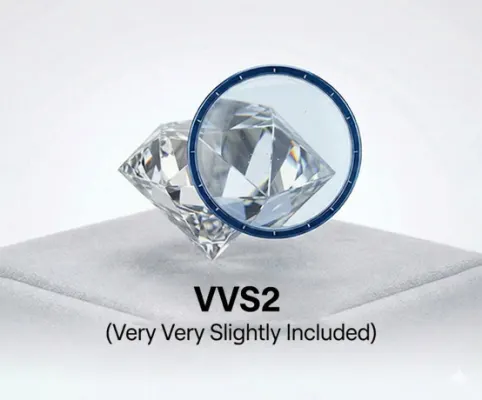
- VVS2 diamonds have extremely tiny inclusions that are very hard to spot under 10x magnification.
- They offer near-flawless clarity at a more affordable price than VVS1 or Flawless.
- Ideal for buyers seeking pristine appearance without paying a huge premium.
- The inclusions in VVS2 are typically located at the edges or are microscopic.
Rian here. We've written these clarity grade articles to give you the nitty gritty on each diamond clarity grade. You can also get the big picture: view our page on the diamond clarity scale or read more posts in diamonds 101 about specific diamond clarity grades. Enjoy!
The Details About VVS2 Clarity Diamonds
Here we are at level two of the ‘very, very slightly included’ bracket. ‘VVS2’ clarity grade diamonds are the ‘fun’ friend of the ‘VVS1’s.
‘VVS2’ diamonds will not have one large inclusion, but will rather have a number of ‘VVS1’ quality inclusions like pinpoints and needles. The other main difference is that ‘VVS2’ stones will likely have a slightly more noticeable inclusion when looking at the face (top) of the diamond.
That said, these inclusions are still only visible under 10x magnification! Bottom line, a ‘VVS2’ diamond (just like its better-behaved friend ‘VVS1’) is still absolutely eye-clean.
Here's how VVS2 stacks up against VVS1 and VS1:
| Clarity Grade | Inclusion Type | Visible Under 10x? | Naked-Eye Visible? | Price vs. VVS2 |
|---|---|---|---|---|
| VVS1 | Very few, tiny pinpoints or needles | Extremely hard to spot | No | Higher |
| VVS2 | Multiple small pinpoints or needles | Hard to spot, slightly more visible face-up | No | Baseline |
| VS1 | Minor inclusions, slightly larger | Visible with more effort | No | Lower |
VVS2 Diamond Drawbacks
The main problem for me when it comes to ‘VVS2’ is the price. People tend to make a mistake when it comes to this clarity in particular, choosing it over lower grades such a ‘VS1’ because they think they’re getting a much better diamond. It’s down to the psychology of the quality bands – going for a ‘very, very slightly included’ stone must be better than going for a ‘very slightly included’ one, right?
Wrong. A 'VVS2' and a 'VS1' will look the same to the naked eye. The lower graded stone may have more inclusions in noticeable places, but you won't see them. Unfortunately, there will be a difference in price between those two, as retailers will count on you getting all fancy and opting for the better sounding grade.
Natural vs. Lab-Grown VVS2 Diamond Prices
But that price gap is small compared to natural versus lab-grown. Lab-grown diamonds generally cost 60% to 87% less than natural diamonds at the same specs.
Here's what that looks like at Rare Carat, for VVS1, VVS2, and VS1, at 1 carat, round, G color, Excellent cut:
Prices reflect real data pulled directly from Rare Carat's own inventory in 2026 and may fluctuate based on availability. This table compares lab-grown vs. natural pricing at the same clarity grade, all sourced through Rare Carat.
So if you're deciding between VVS2 and VS1, that's a rounding error next to natural versus lab. Same clarity, same eye-clean look, a fraction of the price.
Why choose a VVS2 clarity diamond?
What should you check when considering a VVS2 diamond?
Is there a visible difference between VVS2 and higher clarity grades in everyday wear?

VVS2 Clarity Diamond FAQs