Engagement Ring Trends 2027: Yellow Gold and Elongated Shapes Take the Lead
What Rare Carat sales, 10,000+ couples and three years of US search data say about the next proposal season
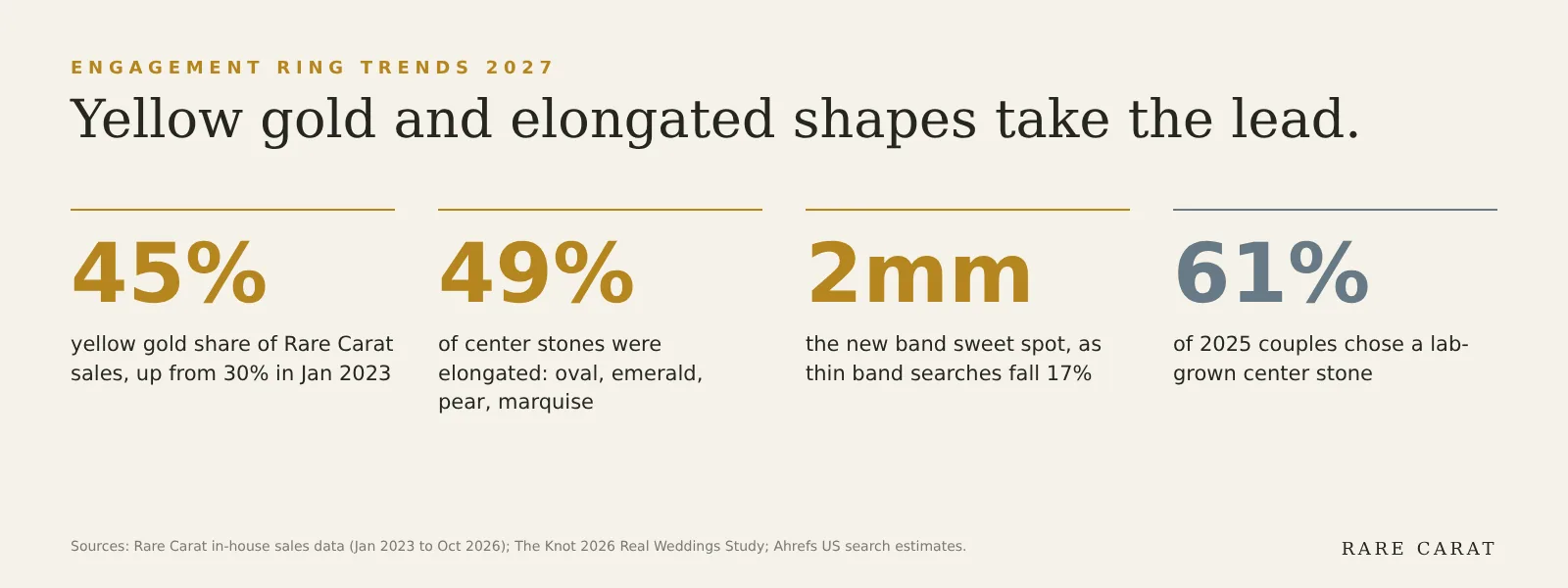
- Yellow gold's share of Rare Carat sales rose from 30% to 45% since January 2023, and it was the top single metal for 2025 weddings.
- Elongated shapes (oval, emerald, pear and marquise) made up 49% of center stones, nearly double round.
- Marquise is the breakout shape, with about 41,000 US searches a month, up 13% in a year.
- Bands are moving to about 2mm as thin and skinny band searches fall 17%.
- Lab-grown leads with 61% of center stones, averaging 2 carats.

Two engagement ring trends will define 2027: a return to warm gold and the rise of elongated shapes, led by the marquise. We analyzed three years of estimated US Google search demand for ring styles, shapes, metals and band widths (November 2023 to October 2026), alongside our own in-house sales data, and compared both with The Knot's 2026 Real Weddings Study of more than 10,000 couples married in 2025.
Yellow Gold Is the Metal of 2027
Nationally, yellow gold has overtaken white gold as the most chosen single ring metal. The Knot found 39% of couples married in 2025 chose it, up 140% in five years, against 35% for white gold and 13% for platinum.
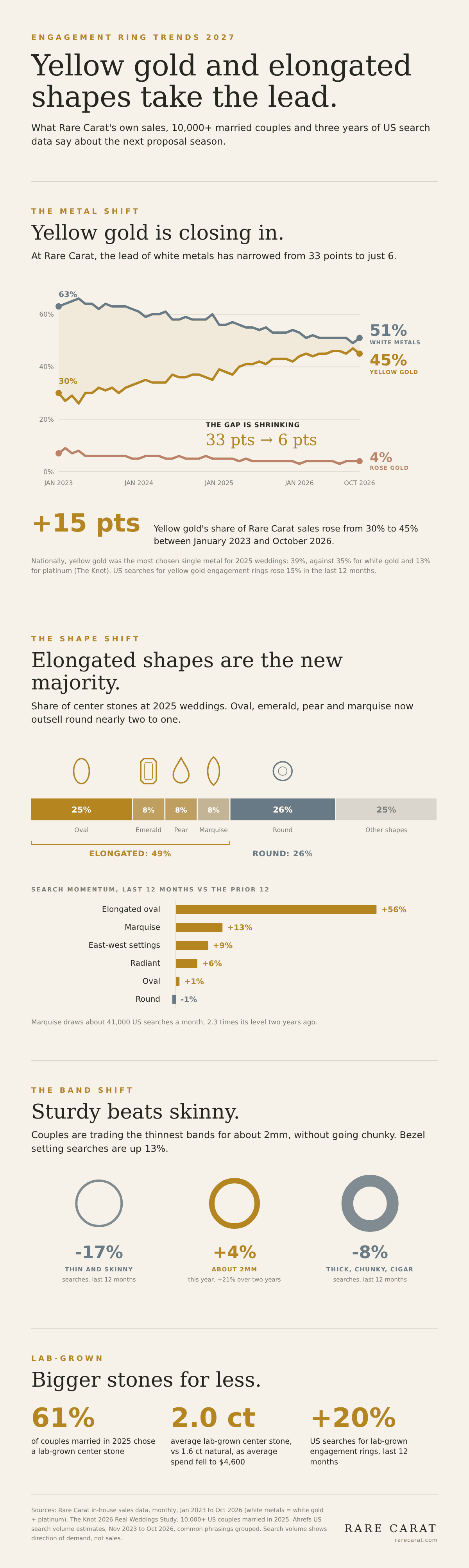
Our in-house sales data, charted above, shows the shift in motion. Yellow gold's share of Rare Carat's monthly sales rose from 30% in January 2023 to 45% in October 2026. Over the same period, white metals (white gold and platinum combined) fell from 63% to 51%, so their lead narrowed from 33 points to just 6. Rose gold slipped from 7% to 4%.
Search demand points the same way. US searches for yellow gold engagement rings rose 15% in the last 12 months and 25% over two years, while white gold rose 2% and platinum was flat.
"Our rate of yellow has climbed from 30% to about 45% in under four years, and the gap with white metals is down to six points. Warm gold suits the elongated cuts couples are choosing, especially marquise and oval, and it works with the gold jewelry they already wear every day."
Paul Forman, Chief of Operations, Rare Carat
There are practical reasons behind the shift. Unlike white gold, which is usually rhodium plated and needs replating over time to stay bright, the warmer metal keeps its natural color. It also coordinates with everyday gold jewelry, a point designers raised in National Jeweler's 2026 trend report.
Elongated Shapes Take the Lead, With Marquise Out Front
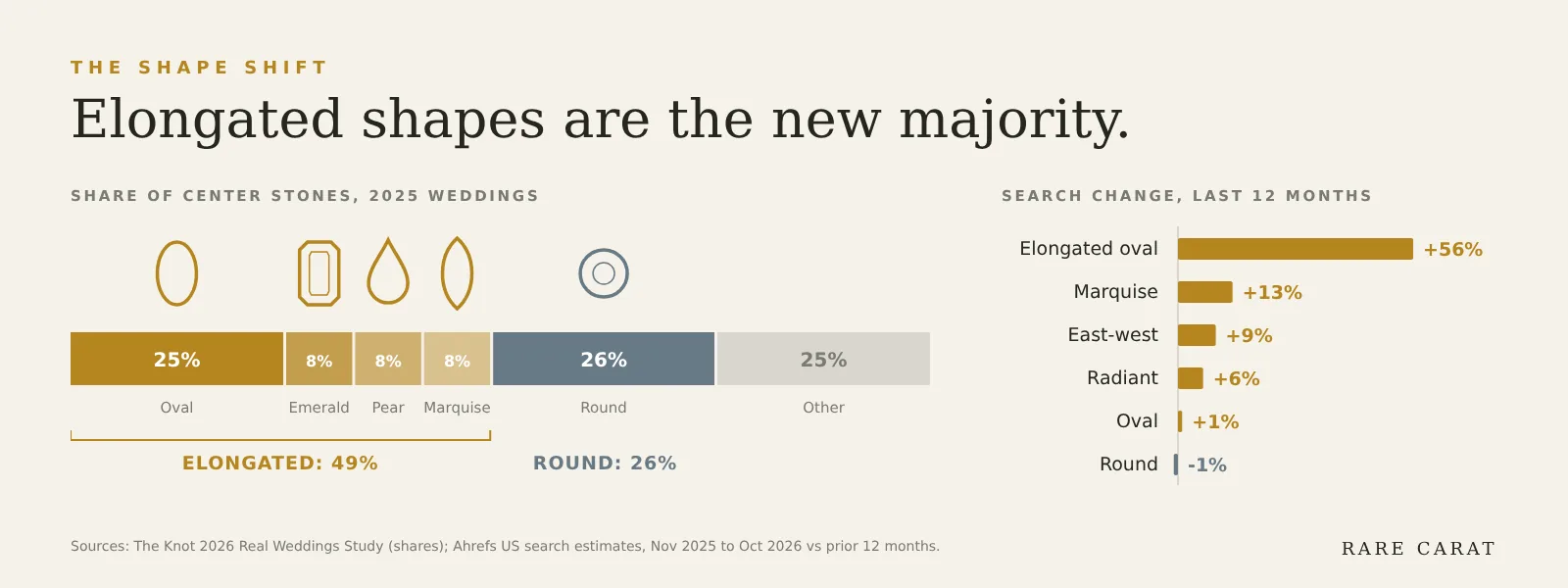
Elongated diamonds have moved from alternative to mainstream. Oval (25%), emerald (8%), pear (8%) and marquise (8%) together made up 49% of center stones in The Knot's study, nearly double round at 26%. An elongated cut spreads its weight across a longer outline, so it tends to look larger face up than a round of the same carat weight, and it visually lengthens the finger.
Marquise is the shape with the most momentum. Marquise rings and diamonds draw about 41,000 US searches a month, up 13% in a year and 2.3 times their level of two years ago.
The oval is evolving rather than fading. Oval searches overall held flat (up 1%), while interest in elongated ovals, a slimmer version with a higher length-to-width ratio, rose 56%. The rest of the shape picture:
- East-west settings: up 9% in a year and double their level of 24 months earlier, as couples set ovals, emeralds and marquise stones sideways.
- Radiant: up 6%.
- Pear and emerald: steady at high volume, each up 1%.
- Round: flat, down 1%.
Bands and Settings: Sturdy Beats Skinny
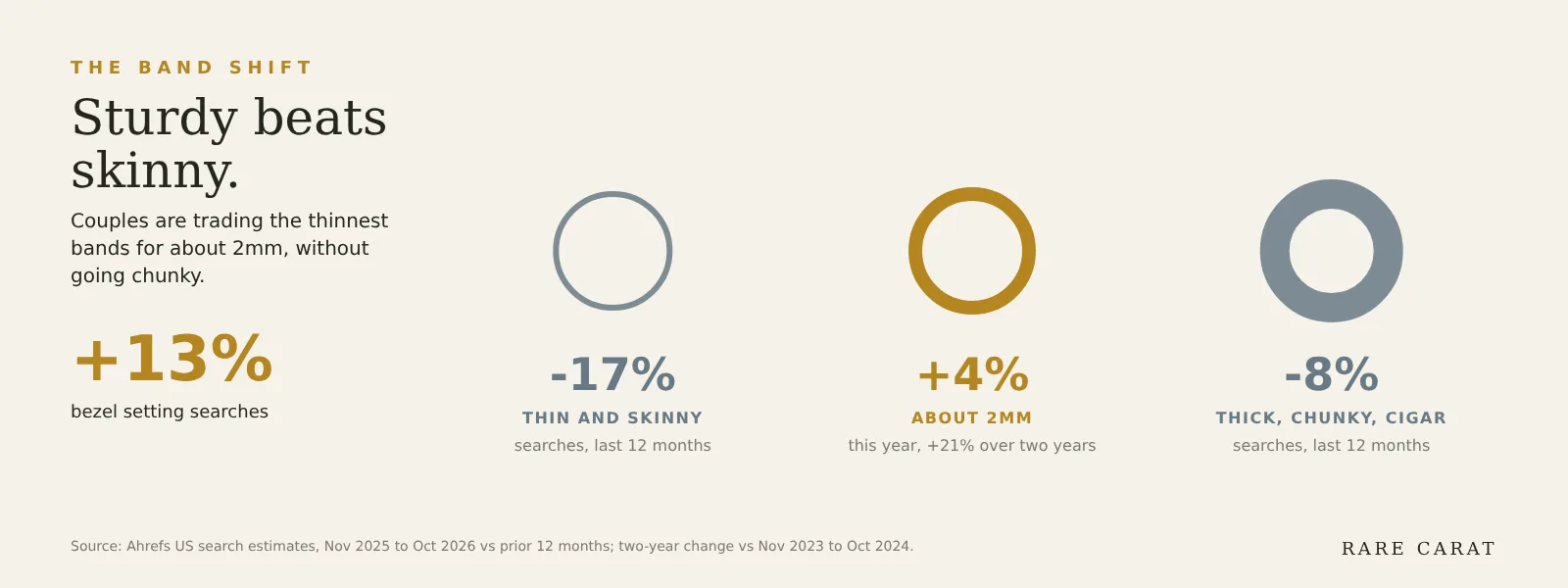
Couples are moving away from the thinnest bands. Thin and skinny band searches fell 17% over the past year, while 2mm bands held steady (up 4%) and are up 21% over 24 months. Very wide styles are not the answer either: interest in thick, chunky and cigar bands eased 8% this year.
"We are seeing bands shift toward 2mm and wider. Couples still want an elegant ring, but they want one that feels solid and will hold up to everyday wear."
Paul Forman, Chief of Operations, Rare Carat
Bezel settings, which wrap the stone in a rim of metal, are the setting style on the rise. Bezel searches average about 13,800 a month, up 13% in a year and 52% over two years. A bezel protects the edge of the stone and suits the clean, sturdy look couples want.
Solitaires remain the most purchased setting, chosen by 38% of buyers in The Knot's study. Two-stone toi et moi designs also drew more searches (up 15%), though solitaires remain far more common.
Lab-Grown Keeps Setting the Size
Lab-grown diamonds are now the majority choice. The Knot found 61% of couples married in 2025 chose a lab-grown center stone, up 239% since 2020. BriteCo's appraisal data, a separate measure, puts lab-grown at 51% of engagement rings appraised in the first half of 2026.
Size is where the shift shows. The average lab-grown center stone reached 2 carats, against 1.6 carats for natural, while average ring spend fell to $4,600 from $5,200. US searches for lab-grown engagement rings grew 20% in the last 12 months and 50% over 24 months. Moissanite searches were flat this year and are down 11% over the same longer period. Natural diamonds keep a clear place for buyers who want rarity and a stone formed in the earth.
The 2027 Engagement Ring Trends at a Glance
See the full infographic for every chart in this report.
What These Engagement Ring Trends Mean for Shoppers and Jewelers
The peak season is starting now: about 40% of proposals happen between Thanksgiving and Valentine's Day, and 57% of couples start looking more than six months ahead, per the Real Weddings Study.
For shoppers
- Pair an elongated shape with warm gold. The metal frames marquise, oval and pear outlines well.
- Check the length-to-width ratio. It decides how slim an oval or marquise looks, so compare a few before choosing.
- Choose a band around 2mm. It balances an elegant look with everyday durability.
- Put lab-grown savings into cut quality first, then size.
For jewelers and retailers
- Lead with gold samples of best-selling settings.
- Stock marquise, elongated oval and east-west options in lab-grown around 2 carats.
- Offer 2mm bands and bezel versions of core solitaires.
Couples can browse more than 2 million natural and lab-grown diamonds and 2,300+ ring styles at Rare Carat, and our gemologists are available to help with anything from shape and ratio to metal and band width.
Methodology and Sources
Search figures are estimated monthly US Google search volumes from Ahrefs Keywords Explorer, grouping the common phrasings of each style, shape, metal and band width. Year-over-year change compares November 2025 to October 2026 with the prior 12 months; two-year change compares with November 2023 to October 2024. Search volume shows the direction of demand, not sales. For last year's outlook, see our 2026 engagement ring trends.
- The Knot 2026 Real Weddings Study (10,000+ US couples married in 2025), as reported by JCK (February 25, 2026) and Rapaport (February 19, 2026)
- National Jeweler, Engagement Ring Trends 2026: What's In, and Why (March 5, 2026)
- BriteCo Jewelry, Diamond and Watch Price Index 2026, as reported by Stacker (September 24, 2026)
- Metal share: Rare Carat in-house sales data, monthly, January 2023 to October 2026
What are the biggest engagement ring trends for 2027?
Is yellow gold more popular than white gold for engagement rings?
Which diamond shapes are trending for 2027?
Is an oval engagement ring still in style?
What band width is trending for engagement rings?

Trending Engagement Ring FAQs