Best Place to Buy Oval Diamond Engagement Rings
A guide to choosing oval diamond engagement rings, from shape to settings and buying confidence
- Oval diamonds are popular because they look larger than rounds and create a slender finger effect.
- Small differences in bow-tie effect and length-to-width ratio greatly impact appearance.
- Certification matters, but visual evaluation with videos is essential for ovals.
- Rare Carat offers verified, GIA-certified diamonds with expert gemologist support.
- Natural and lab-grown options are available, with settings ranging from solitaire to halo.
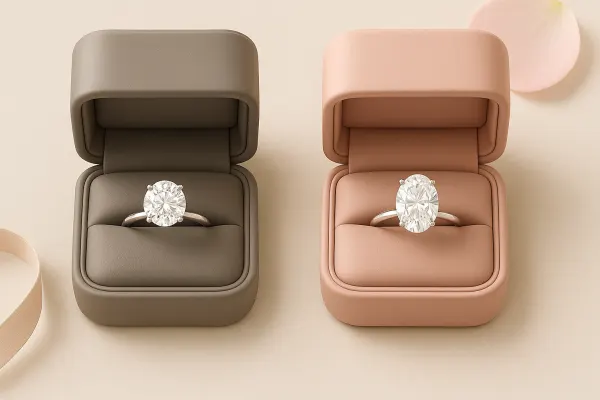
For many buyers, the search for engagement rings with oval-shaped diamonds doesn't begin with a retailer. It begins with the shape.
Some people are drawn to how an oval diamond appears slightly larger than a round diamond of the same carat weight. Others like the elongated silhouette, the softer outline, or the way the shape can create a more slender look on the finger.
Whatever brings someone to oval diamonds in the first place, the next challenge is usually figuring out where to buy one.
That's often easier said than done.
An oval diamond may look beautiful in a product photo, but comparing two seemingly similar stones online can quickly become complicated. Questions about the bow-tie effect, proportions, certification, pricing, and overall light performance tend to appear long before a final decision is made.
And unlike some diamond shapes, small differences in an oval can have a surprisingly large impact on how the finished ring looks in person.
That's one reason many shoppers start by researching the best online destination for engagement rings before narrowing their search to a specific shape. Once the focus shifts to oval diamonds, however, a different set of considerations starts to matter.
The best place to buy oval diamond engagement rings isn't necessarily the retailer with the largest selection.
What tends to matter more is how easy it is to compare similar diamonds, understand the differences that actually affect appearance, explore different ring settings, and get help when questions come up along the way.
In the sections below, we'll look at what makes oval diamonds different from other shapes, what buyers often overlook during the shopping process, and why many shoppers choose Rare Carat when looking for the best place to buy engagement rings with oval diamonds.
1. Why Oval Diamond Engagement Rings Continue to Be So Popular
Oval diamonds have been around for decades, but their popularity has grown noticeably over the past several years.
Part of that comes down to appearance.
Part of the appeal is the shape itself. The elongated outline gives oval diamonds a different look and feel than a classic round diamond. The outline feels a little softer, a little less expected, while still delivering plenty of sparkle.
There's also another reason oval diamonds frequently end up on buyers' shortlists.
They tend to look larger than many other diamond shapes of the same carat weight.
Because of the way the shape is cut, an oval diamond often looks a bit larger than a round diamond with the same carat weight. That visual advantage is often appealing to shoppers who want maximum presence without automatically moving into a higher carat category.
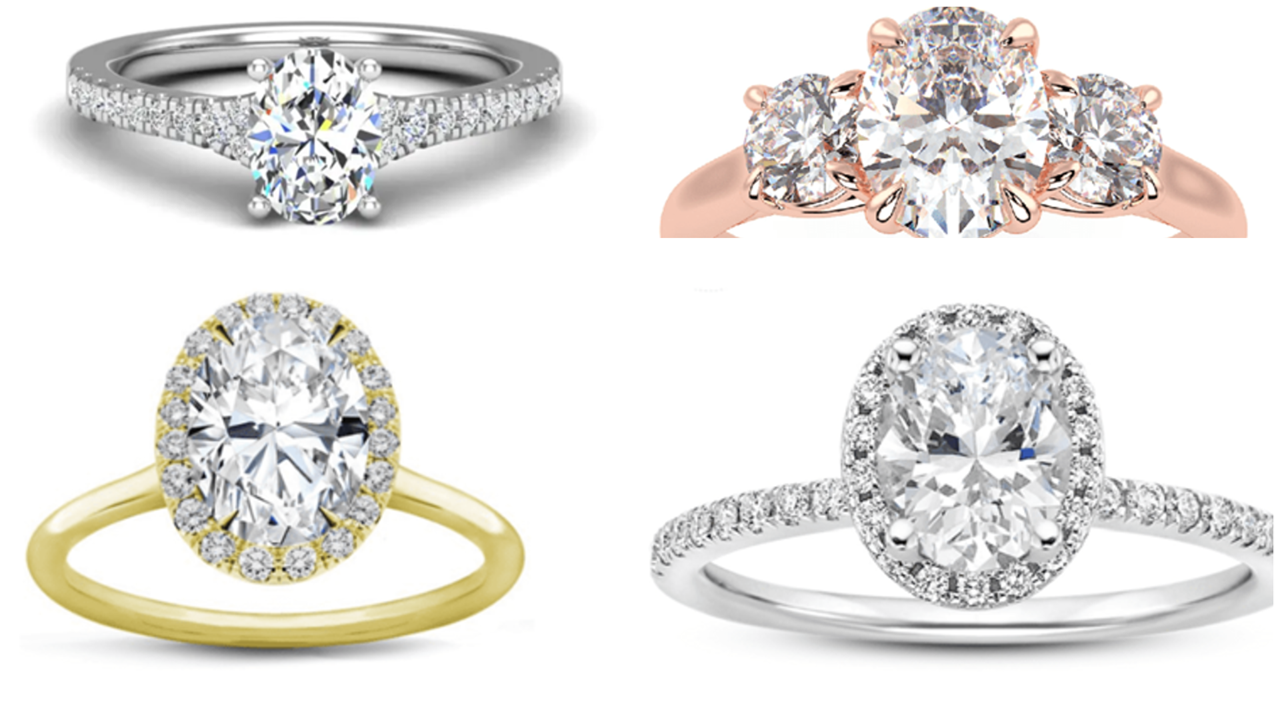
For some buyers, the appeal is mostly aesthetic. For others, it's practical.
Oval diamonds for engagement ring styles can help balance several priorities at once:
- Strong visual size relative to carat weight
- A shape that works with both classic and modern settings
- Plenty of brilliance and light return
- A flattering elongated appearance on the finger
- Wide availability in both natural and lab-grown diamonds
That combination is one reason oval diamonds are frequently compared against round, cushion, and pear-shaped diamonds during the shopping process.
Why popularity alone doesn't make every oval diamond a good choice
One thing many first-time buyers discover is that oval diamonds can vary more than expected.
Two stones with the same carat weight, color grade, clarity grade, and certification can still look noticeably different once they're viewed side by side.
Length-to-width ratio, overall proportions, and something known as the bow-tie effect can all influence how attractive an oval diamond appears in real life.
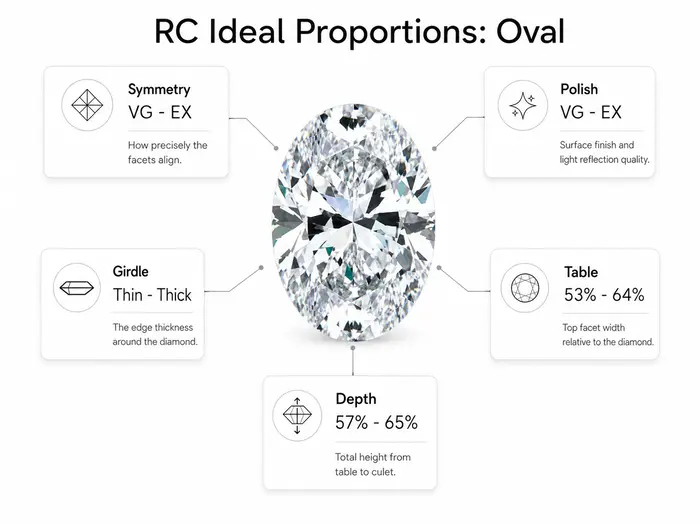
That's why comparing oval diamonds often requires a closer look than many buyers initially expect. Small differences in proportions can have a surprisingly large impact on how the finished ring looks once it's actually worn.
Why Oval Diamonds Often Need a Closer Look
With many diamond shapes, the grading report tells a large part of the story.
Oval diamonds are a little different.
Certification still matters, but once buyers start comparing actual stones, appearance often becomes just as important as the specifications on paper.
Two oval diamonds can have very similar grades and still look surprisingly different when viewed side by side. Things like bow-tie visibility, length-to-width ratio, and overall light performance don't always become obvious from a grading report alone.
That's often where the shopping process changes. Buyers stop looking only at the certificate and start paying closer attention to how the diamond actually looks.
That's one reason many buyers prefer retailers that make visual evaluation easier before a purchase is made.
At Rare Carat, shoppers can browse both natural and lab-grown oval diamonds (certified by GIA, IGI, or GCAL) from the very beginning, allowing them to focus on the option that best matches their priorities and budget.
Each certified stone at Rare Carat is shown with high-definition images and 360° videos, making it easier to see details that can be especially important with oval diamonds. Buyers can look at the diamond from different angles, get a better sense of its overall shape, and spot details that aren't always obvious from the grading report alone.
And if a diamond looks similar on paper but feels different in practice, help is available. Rare Carat's team of more than 100 GIA-certified gemologists can answer questions and help explain differences that aren't always easy to identify from the specifications themselves.
Because with oval diamonds, the challenge is rarely finding options.
It's figuring out which one is actually the right choice.
2. What Actually Makes One Oval Diamond Look Better Than Another?
Once buyers decide that an oval diamond is the shape they want, a new challenge usually appears.
How do you tell the difference between two oval diamonds that seem almost identical?
On paper, the comparison can look straightforward.
The carat weight is similar. The color grade is similar. The clarity grade is similar. The cut grade is similar. Both diamonds may even have certification from the same grading lab.
And yet one diamond often looks noticeably more attractive than the other.
This is one of the reasons oval diamonds tend to require more careful evaluation than many buyers expect.
| What Buyers Expect | What Actually Affects Oval Diamond Appearance |
|---|---|
| Similar 4Cs means similar appearance | Cut proportions and facet arrangement can create very different visual results |
| Certification tells the full story | Reports do not show bow-tie visibility or light behavior in real viewing conditions |
| All oval diamonds look proportionally similar | Length-to-width ratio can significantly change how the diamond looks on the finger |
| Brightness is consistent across stones | Light return varies based on cut precision and internal symmetry |
| Product photos are enough for comparison | True differences often appear only in video or multi-angle viewing |
Unlike some diamond shapes, appearance isn't determined by the 4Cs alone.
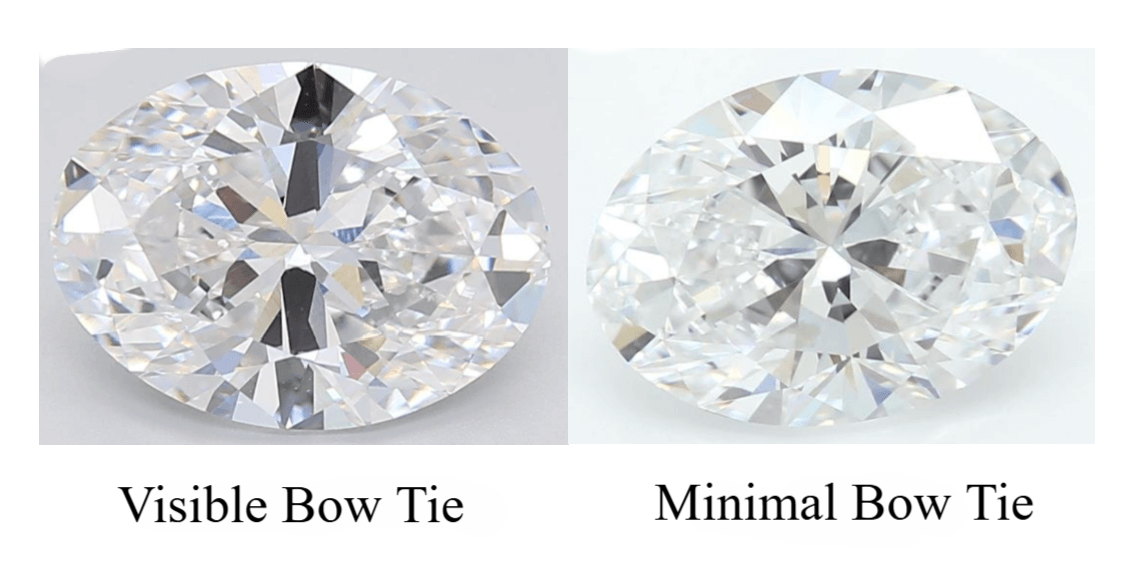
The Bow-Tie Effect
If you've spent any time researching oval diamonds, you've probably come across the term "bow-tie effect."
It's the darker area that can sometimes appear across the center of an oval diamond.
A small bow tie is completely normal and appears in many well-cut oval diamonds.
The problem arises when it becomes too prominent.
In stronger cases, the dark area can become distracting and reduce the diamond's overall brightness.
Because bow-tie visibility isn't assigned a grade on a certification report, it's often something buyers need to evaluate visually rather than relying on the certificate alone.
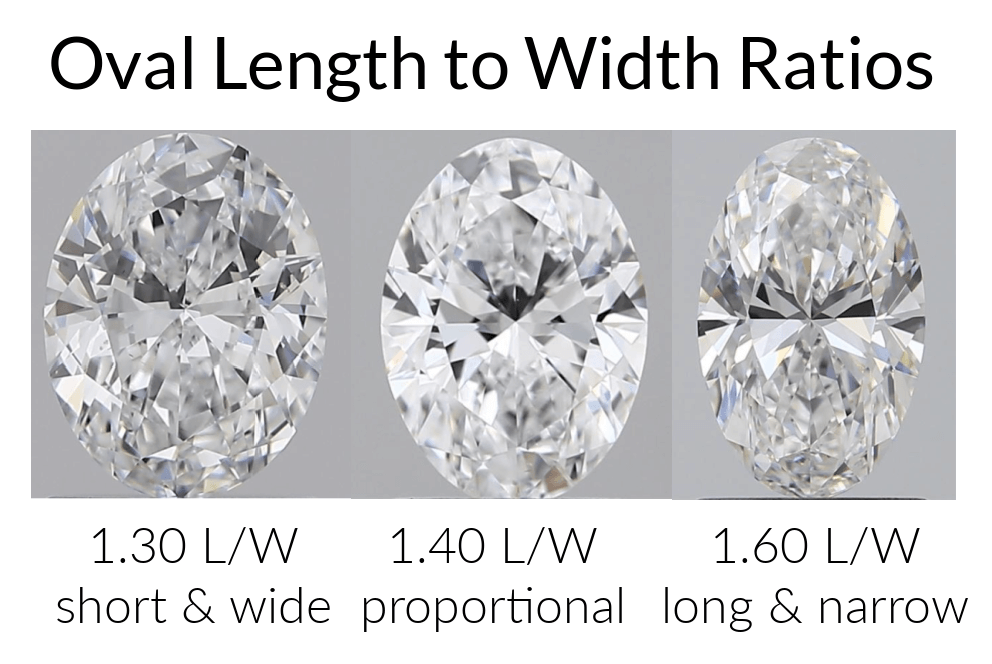
Length-to-Width Ratio Changes the Personality of the Diamond
Not all oval diamonds have the same outline.
Some appear longer and slimmer. Others look wider and more rounded.
Neither option is automatically better.
It is all about personal preference in the end.
A more elongated oval tends to give the finger a longer, more slender look, while a slightly wider oval often feels softer and a bit more rounded overall.
The important thing is consistency. Small differences in ratio can noticeably change how the finished engagement ring looks once it's worn.
Why Two Oval Diamonds With Similar Grades Can Still Look Different
This is where many buyers become surprised.
Two oval diamonds can have the same color, clarity, and carat weight on paper and still look quite different once you see them in real life.
Small details like how the facets are arranged, the way light travels through the stone, its exact proportions, and how precisely it’s cut all come together to shape how much sparkle and life a diamond actually shows.
That’s why many experienced buyers don’t rely on the grading report alone.
The certificate gives you the technical foundation, but the real character of the diamond often becomes clear only when you actually see how it performs visually.
For oval diamonds especially, appearance and performance tend to work together.
And that's exactly why comparing the diamonds carefully becomes one of the most important parts of the buying process.
3. Why Certification and Verification Still Matter After You’ve Found a Diamond You Like
Once a buyer gets down to a specific oval diamond they’re seriously considering for the engagement ring, the way they think about it changes.
At that point, it’s not about scanning through endless options anymore or trying to compare broad differences between stones. At this stage, the focus becomes much more personal: Is this the diamond I actually want to commit to?
And that’s where certification starts to matter in a slightly different way.
A GIA, IGI, or GCAL report is no longer used to compare diamonds side by side. Instead, it becomes a reference point for something simpler but more important—confirmation.
Confirmation that the diamond has been graded independently. Confirmation that the specifications are consistent with industry standards. Confirmation that what looks good visually also holds up technically.
In other words, the certificate stops being a comparison tool and starts becoming a trust anchor.
From “this looks good” to “this is exactly what it claims to be.”
At this stage of the buying process, most hesitation is no longer about appearance.
It’s about certainty.
Even when a diamond looks right in images and videos, buyers naturally start asking a quieter set of questions:
- Is this the exact stone shown in the listing?
- Will the diamond I receive match what I’ve been looking at online?
- Has anything been misrepresented, even unintentionally, between sourcing and delivery?
These aren’t questions that grading reports are designed to answer on their own. Certification describes the diamond—but it doesn’t physically verify the journey of that specific stone from listing to delivery.
That’s where additional verification becomes meaningful.
How verification adds another layer beyond certification
Once a diamond is selected, some retailers introduce an extra step to ensure the stone matches its documentation before it ever reaches the customer.
At Rare Carat, each certified diamond also goes through an additional verification step before it’s finally fulfilled.
The goal is simple—to ensure the diamond being purchased is not only correctly graded but also truly matches what the buyer has seen and been presented with throughout the process.
This includes checks such as matching the microscopic laser inscription on the diamond with its certificate details under magnification, confirming identity at the stone level rather than relying only on paperwork.
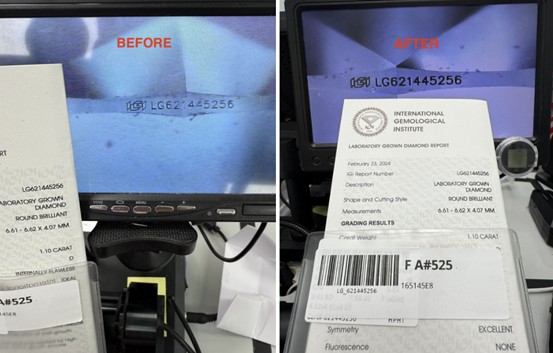
It’s a quiet step in the process, but an important one—especially for buyers who are already making a high-consideration decision.
Because at this point, even small uncertainty is no longer about knowledge gaps.
It’s about peace of mind.
Why does this matter most after the decision is already made
What makes this stage interesting is that the hardest part of the journey is usually already behind the buyer.
They’ve chosen the shape. They’ve compared options. They’ve looked closely at visuals and trade-offs.
Now the expectation changes.
It’s no longer about discovering information—it’s about ensuring nothing gets lost between what was seen and what is delivered.
That’s why certification and verification still play a role even after selection.
Not to help choose the diamond.
But to confirm the choice was the right one.
4. Real Oval Engagement Ring Style Examples
Once buyers feel confident about the diamond itself, the focus usually shifts to how that oval diamond actually comes to life in a ring.
This is where settings start to matter just as much as the stone. The same oval diamond can feel completely different depending on how it’s mounted, how much detail surrounds it, and how the overall design frames the center stone.
Oval diamonds are especially flexible in this way. They fit comfortably into a lot of different settings—from very simple, understated designs to ones with more detail and extra sparkle.
Here’s a quick breakdown of the most common oval engagement ring settings and how each one usually changes the overall look:
Oval Diamond Engagement Ring Settings Overview
| Setting Style | How It Changes the Oval Diamond | Overall Look & Feel |
|---|---|---|
| Solitaire Setting | Keeps full focus on the oval diamond without distractions | Clean, classic, and minimal |
| Hidden Halo Setting | Adds subtle sparkle beneath the center stone without overpowering it | Elegant with a soft hidden brilliance |
| Pavé Band Setting | Enhances overall sparkle along the band while keeping the oval center dominant | Balanced, detailed, and slightly glamorous |
| Halo Setting | Surrounds the oval diamond with smaller stones to increase visual size | Bold, bright, and high-impact |
| Three-Stone Setting | Adds side stones that frame and enhance the center oval diamond | Symbolic, balanced, and dimensional |
| Vintage-Inspired Setting | Introduces intricate detailing that complements the soft oval outline | Ornate, romantic, and timeless |
Once you start seeing how each setting changes the character of an oval diamond, the decision becomes less about theory and more about taste.
Some designs feel understated and minimal, where the oval remains the clear focal point. Others add layers of detail that bring more sparkle, contrast, or structure to the overall ring. And then there are styles that sit somewhere in between—balanced, versatile, and easy to wear every day.
This is usually the point where buyers move from comparing settings in general to looking at real engagement rings that already bring these combinations to life.
To make that easier, a few of the most popular natural oval engagement ring styles people tend to gravitate toward are highlighted next—each one showing how different settings and designs actually look when they come together in a finished piece:
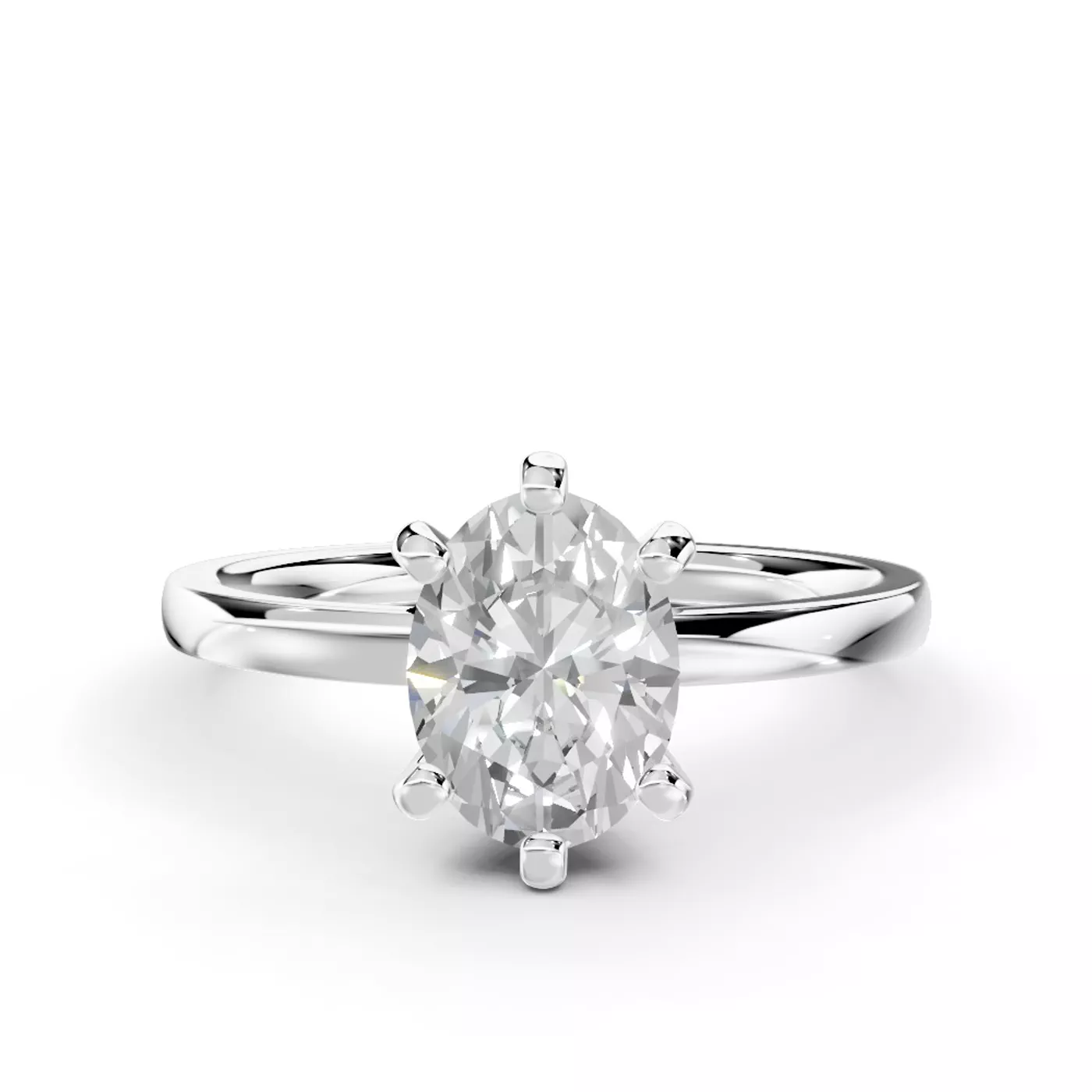
- A Classic Solitaire Ring with Six Prongs
This solitaire setting is designed to let an oval diamond take center stage, highlighting its elongated shape and natural brilliance without distraction. The six-prong setting keeps the oval diamond secure while softly outlining its shape, giving it a balanced, classic feel that doesn’t overpower the stone.
The slim 1.5mm comfort-fit band feels easy and natural on the finger, while the softly pinched, high-polished sides give it a clean finish that’s refined without trying too hard.
It’s a bestseller because it doesn’t try to do too much—it stays simple, elegant, and quietly lets the oval diamond take center stage.
- A Hearts & Arrows Pavé Hidden Halo Ring
This hidden halo setting is built for maximum sparkle, with Hearts & Arrows pavé diamonds flowing up the band and naturally guiding the eye toward the center stone. A hidden halo sits just under the basket, giving the oval a soft glow that adds a bit of lift without stealing focus from its shape.
The 1.5mm band keeps the look slim and refined, and the precise detailing helps the ring stay bright from every angle. From the top, it feels clean and balanced, and from the side, it starts to show a little more depth and movement as the light catches.
It’s especially well-suited for oval diamonds because it enhances their elongated outline while adding just the right amount of surrounding sparkle to lift the overall look without overwhelming it.

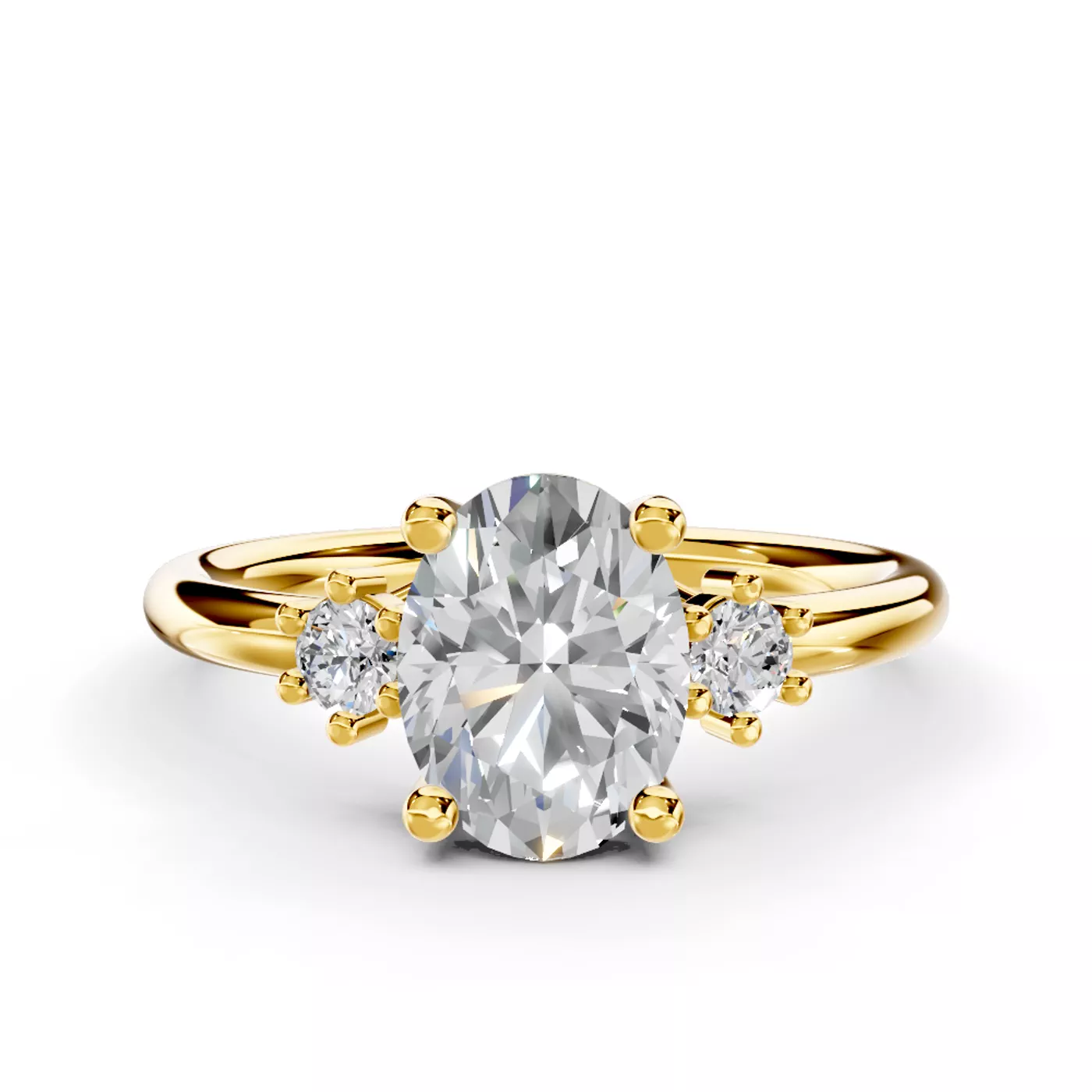
- A Petite Three-Stone Ring with Six-Prong Side Accents
This three-stone setting feels classic and steady, with side diamonds held in six prongs that sit around the center stone without pulling attention away from it.
This setting style carries the traditional past, present, and future meanings in a simple, understated way.
The slim 1.40–1.60mm band keeps everything feeling light and delicate, so the center stone naturally stays in focus while the side diamonds add just a hint of structure and balance.
From a distance, it feels clean and minimal, and as you look closer, the small, thoughtful details in the design start to stand out.
- A Reverse Tapered Cathedral Halo Ring with Pavé Band
This is one of those designs where the shape of the ring quietly leads your eye without you even realizing it. The band rises as it moves toward the center oval stone, and along the way, small pavé diamonds catch light in a soft, continuous line.
The halo adds another layer of brightness, but it doesn’t overwhelm anything—it just helps the center stone feel a bit more defined and present.
With a 2.00mm band, the ring has a slightly stronger base, but it still keeps that refined, elegant feel. As it moves, the pavé detailing shifts between subtle shimmer and brighter flashes depending on the angle.
Nothing here feels loud or overworked—it’s really just a steady build of light and structure that naturally brings focus to the oval shape of the center stone.

- A Twisting Pavé Ring in Platinum
There’s a bit of motion in this design that you notice right away—the pavé diamonds don’t sit in a straight line; they wrap around the band in a soft twist.
It gives the ring a flowing kind of sparkle, almost like it’s moving with your hand instead of just sitting still. The pavé adds a steady line of sparkle, but it never takes over—it just supports the center oval instead of competing with it.
Each stone is set to catch light differently, so the shine keeps shifting as your hand moves, rather than staying in one flat direction. Even with the twist in the band, the whole piece still feels composed and visually calm.
The slightly wider 2.70–3.22 mm band also gives it a bit more presence on the finger, while still keeping that clean, elegant feel.

Natural vs Lab-Grown Oval Engagement Rings (Same Specs, Different Price Perspective)
At this point, most buyers are no longer asking what an oval diamond is or which setting looks best. The real question becomes how the same design changes depending on whether the diamond is natural or lab-grown—especially when everything else (cut, clarity, color, and setting) is kept identical.
Here’s a simple side-by-side view using the same ring structure and specifications:
| What Buyers Compare | Oval Lab-Grown Diamond Engagement Ring | Oval Natural Diamond Engagement Ring |
|---|---|---|
| Same 1.5ct, D–F color, VS clarity, excellent cut | Typically ~30–60% lower price for the same visual appearance and certification standards | Higher price due to natural rarity and sourcing factors, even with identical specs |
| Visual appearance | Indistinguishable from natural diamonds to the eye when matched by cut quality | Identical appearance under matched grading conditions |
| Budget flexibility | Allows larger carat size or higher setting upgrades within the same budget | Budget often prioritizes center stone over setting enhancements |
| Buying priority | Value optimization and size preference | Tradition, rarity, and long-term sentimental value |
| Setting experience | More freedom to explore pavé, halo, or multi-stone designs | Often balanced more conservatively around center stone quality |
5. Why Rare Carat Often Becomes the Final Step in the Oval Diamond Journey
By the time buyers reach this point, most of the uncertainty around oval diamonds has already started to settle. The shape feels chosen. The setting ideas feel more defined. Even the differences between natural and lab-grown diamonds tend to feel clearer than they did at the beginning.
What usually remains is not another comparison—it’s confidence in the decision.
Because at this stage, the focus shifts from what looks right to what feels secure to move forward with.
That’s where Rare Carat naturally fits into the process for many buyers.
Each diamond is independently certified (GIA, IGI, or GCAL) and then supported by an additional verification step designed to ensure the stone matches its listing and documentation before it ever reaches the buyer. It’s a quiet layer in the background, but an important one when the decision is final.
Alongside that, the experience is built with safeguards that reduce uncertainty rather than add to it—insured shipping, a 100% money-back guarantee, 30-Day returns, and access to a support system that includes 100+ GIA-certified gemologists who can help interpret the details that aren’t always obvious on paper.
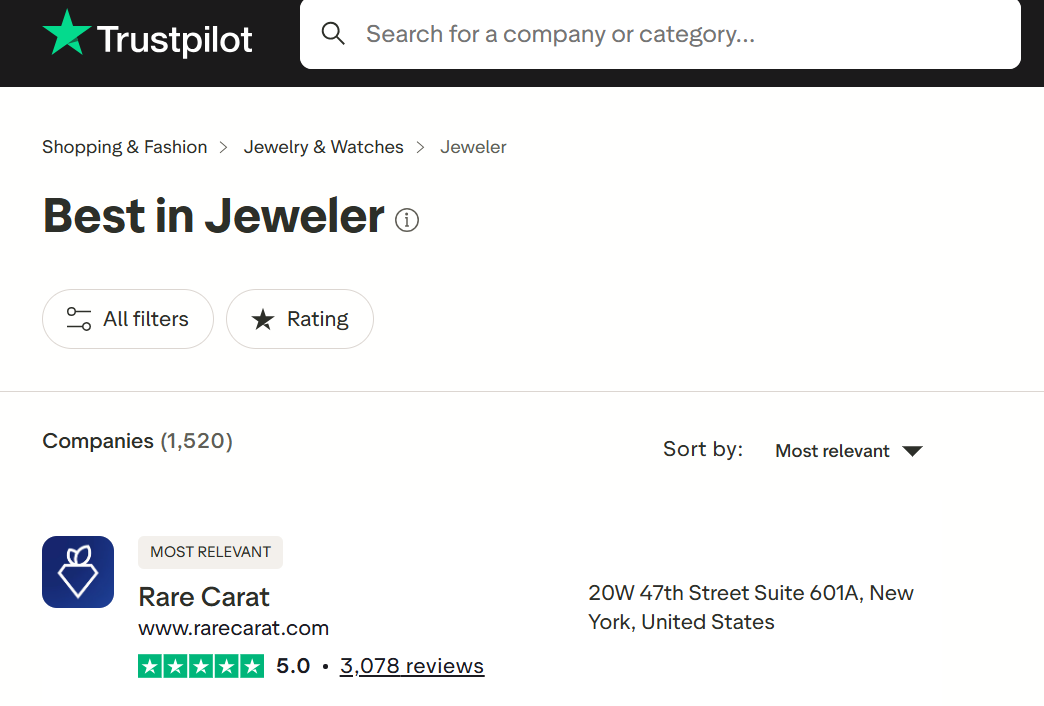
Over time, that combination of verification, protection, and expert guidance is also reflected in buyer feedback, with thousands of verified reviews contributing to a consistent 5/5 rating on Trustpilot.
Put simply, it’s less about adding pressure to decide—and more about removing doubt once the decision is already taking shape.
And for many buyers exploring oval diamond engagement rings, that final layer of reassurance is what brings everything together.
For more, explore our detailed guide on how to find the best oval diamond engagement ring for you.