Best Places to Buy Fancy Diamonds Online in 2026
An in-depth guide to choosing color, intensity and the right grading report
- Fancy color across ten colors of laboratory-grown fancy diamond: yellow, pink, blue, green, brown, orange, black, red, gray and purple
- Intensity filtering from Fancy Light through Fancy Vivid to Fancy Dark, so saturation is a search term rather than a guess
- GIA, IGI and GCAL report options, selectable as a filter before you shop
- Every stone routed through the New York and New Jersey facility for inscription matching at 60x to 110x and UV fluorescence testing
- A 5.0 rating on both Trustpilot and Google, across more than 9,000 combined reviews
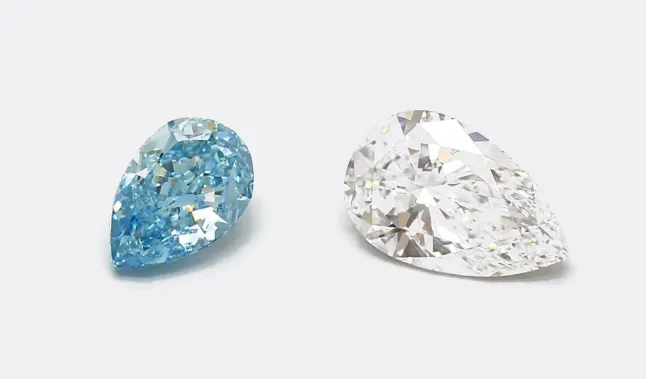
Best Places to Buy Fancy Diamonds Online: Side-by-Side Comparison
Our pick: Rare Carat takes the top spot for buying fancy diamonds online in 2026. Natural fancy color is scarce enough that very few retailers carry it at all, which makes laboratory-grown the practical way most buyers get into color, and Rare Carat, one of the most reputable diamond retailers in the United States, now offers it at a fraction of what fancy color has historically cost. On 16 October 2026 its search listed 80,509 laboratory-grown fancy color diamonds across ten colors, filterable by hue, by intensity from Fancy Light through Fancy Dark, and by certification, so a shopper can browse only stones graded by GIA, IGI or GCAL. A separate lookup tool lets anyone check a GIA or IGI report number directly, whether or not the stone came from Rare Carat.
Shoppers are buying from a merchant of record, so one company handles the checkout, the billing, the shipping and the service afterwards. Every stone is routed through the New York and New Jersey facility before it ships, where staff match the laser inscription to the grading report at 60x to 110x magnification and run UV fluorescence testing.
A 30-day money-back window, free insured shipping and a lifetime manufacturing warranty sit behind the purchase. On catalog size, filtering depth and report verification together, no other retailer on this list matches it.
We compared Rare Carat, Leibish & Co., Tiffany, Kay, Blue Nile, Brilliant Earth, James Allen and independent local jewelers on catalog depth, origin coverage, grading report, intensity range, returns and pre-shipment verification, to find the best place to buy fancy diamonds online in 2026.
| Retailer | Catalog | Natural / Lab | Intensity range | Certification | Return window | Free resizing | Price transparency |
|---|---|---|---|---|---|---|---|
| Rare Carat Best overall for fancy diamonds | 80,509 laboratory-grown fancy color diamonds listed on 16 October 2026, across ten colors; 0.15 to 35 carats | Laboratory-grown only | Fancy Light, Fancy, Fancy Intense, Fancy Vivid, Fancy Deep and Fancy Dark | GIA, IGI or GCAL, selectable as a filter before results load | 30 days, money-back, no restocking fee | Yes, once within the first year; eternity bands within 30 days | Full pricing online with 360° video; commission-free gemologist advice |
| Leibish & Co. | Around 3,300 loose colored diamonds; specialist in Argyle pink and canary yellow | Natural only | Full natural range including Argyle tender material | GIA, Argyle or IGI; the company states some stones carry in-house grading reports | 30 days, no questions asked | Offered only at a Leibish & Co. service center, cost confirmed first; resizing elsewhere voids the warranty | Prices listed per stone online; jewelry settings generally priced on request |
| Tiffany & Co. | House designs only; fancy color offered in yellow | Natural only, with no treatments | Three yellow grades: Fancy Yellow, Fancy Intense Yellow and Fancy Vivid Yellow | A Tiffany Diamond Certificate accompanies engagement rings; the company states many fancy color grades are assigned at its own gemological laboratory | 30 days, refund or exchange; engraved or altered pieces excluded | Complimentary, handled in store | Fixed premium brand pricing; no sales |
| Kay Jewelers | Mall-chain assortment, mostly preset; includes the Le Vian Chocolate Diamonds line in natural brown | Both | Yellow and brown, including Le Vian's C4 to C7 chocolate range | IGI or proprietary store grading on most inventory, with GIA on select collections | 30 days for refunds, 60 for exchanges | Not free; covered only by the paid Lifetime Protection Plan | Constant sale pricing; list prices vary week to week |
| Local jewelers | Varies; usually a small case or a stone sourced on request | Varies | Varies | Varies; ask for the report before any deposit | Varies; often exchange or store credit | Usually | Often no online pricing; negotiable |
| Blue Nile | Natural fancy color in yellow, pink, blue, green, purple, brown, gray and orange; listed stock skews under 0.60 ct | Both | Mostly Fancy and Fancy Light at the sizes listed | GIA; many colored stones carry a Colored Diamond Identification and Origin report, which states color and origin without a full clarity grade | 30 days from shipment; complimentary return shipping capped at two returns per customer per year | One free within 1 year (up to 2 sizes); eternity bands excluded | Full pricing online; 360° imagery |
| Brilliant Earth | Colored lab-grown diamonds in blue, pink, yellow and orange, plus a proprietary Malibu Blue | Lab-grown for colored diamonds | Fancy Light through Fancy Vivid | IGI and GIA on lab-grown colored stones | 30 days after QA inspection; engraved, custom and resized items excluded | One free within 60 days, or within 1 year if inside the ring's range; eternity excluded | Full pricing online |
| James Allen (Out of business) | Legacy medium size inventory; went out of business in 2026 | Both | Not applicable | GIA / IGI (natural and lab) | 30 days; free return shipping limited to three per customer; honored by Blue Nile going forward | Once free within 1 year; eternity and tension rings excluded | Full pricing online with 360° HD video |
Swipe sideways to see all columns. Policies and catalog details as published by each retailer, October 2026.
Where the others fall short: Leibish & Co. stops at natural color, and some of its stones carry in-house reports rather than GIA. Tiffany limits fancy color to yellow and grades many of its own stones rather than sending them to GIA. Kay mixes naturally colored and treated yellow diamonds under one product page, so origin has to be confirmed stone by stone. Blue Nile's natural stock skews small and many of its stones carry a shorter Identification and Origin report instead of a full grading report. Brilliant Earth's selection is laboratory-grown like Rare Carat's, but without the same intensity filtering or report selection. Local jewelers vary shop to shop, with no fixed terms. And James Allen is out of business, with its outstanding returns now handled by Blue Nile.
Natural and lab-grown fancy color are two different purchases
The phrase "fancy diamond" covers two markets that barely overlap on price, and knowing which one you are shopping decides everything that follows.
Natural fancy color gets its hue from conditions during formation. Nitrogen produces yellow, boron produces blue, and the structural distortion behind pink is rare enough that the Argyle mine's closure removed most of the world's supply. That rarity is also why saturated natural stones above a carat reach well into five and six figures, and why very few retailers, Rare Carat included, carry natural fancy color at all.
Laboratory-grown fancy color reaches the same hues through controlled growth and treatment. The stones are chemically and optically diamond, and GIA describes laboratory-grown diamonds as sharing essentially the same properties as natural ones, with origin as the distinction. What changes is availability, and therefore price.
That gap is visible in the figures. On 16 October 2026, Rare Carat listed a 1.67 carat Fancy Vivid Pink round at $890, a 1.46 carat Fancy Vivid Blue at $915 and a 1.67 carat Fancy Vivid Green at $865, all laboratory-grown. A natural stone at that weight and saturation is not priced in hundreds; depending on hue and saturation, a natural Fancy Vivid pink, blue or green diamond around 1.5 carats typically runs from the tens of thousands into six figures. That range is illustrative, not a quote, and moves with the individual stone.
So the honest framing is this. Natural fancy color is scarce and priced accordingly, which is exactly why laboratory-grown has opened fancy color up to buyers who want the color itself, worn daily, at a price comparable to a colorless stone of similar size. That is the opportunity: a shopper can now buy a genuine fancy color diamond, in the hue and intensity they want, from one of the most established diamond retailers in the United States, at a fraction of what natural color has ever cost. If the appeal is instead the rarity of the stone's origin, that is a natural purchase, and it belongs with a natural color specialist rather than here.
Neither is the wrong answer. Confusing the two is where shoppers overpay or get something other than what they thought they bought.
What the fancy color search actually holds
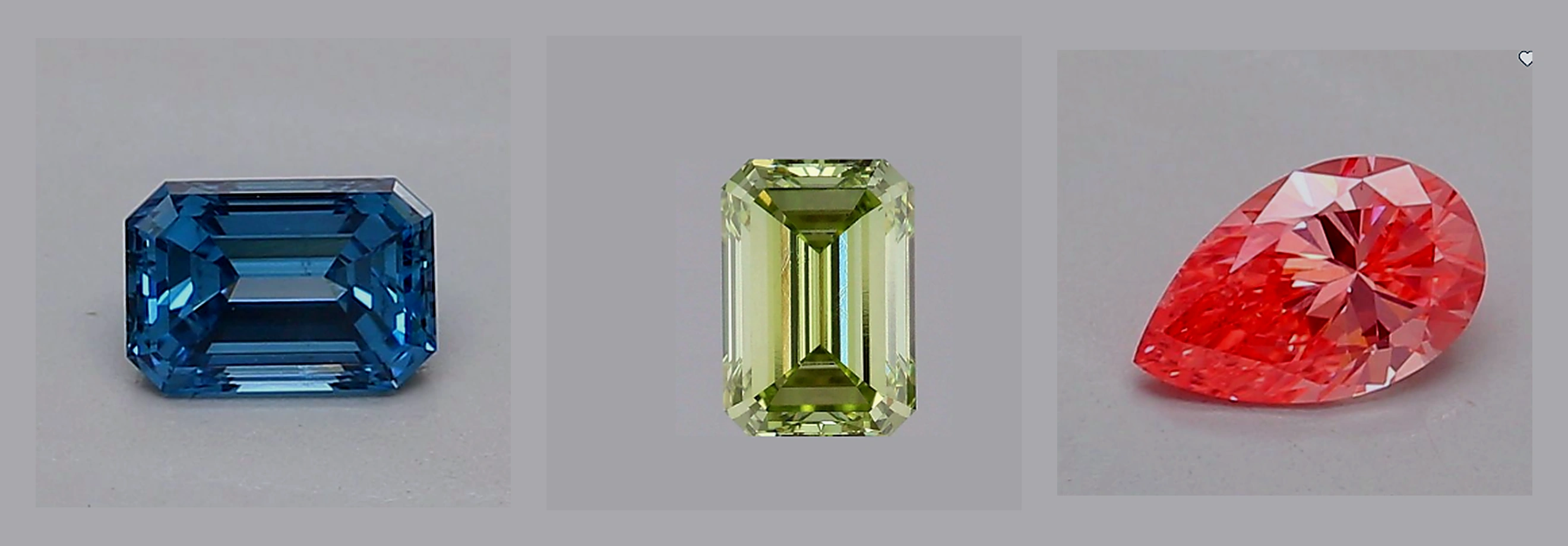
Ten colors sit across the top of the search when you browse fancy color diamonds by color and intensity: yellow, pink, blue, green, brown, orange, black, red, gray and purple. Pick one and the rest of the filters narrow to what exists in that hue, rather than returning an empty grid.

Intensity is a filter, not a guess
Saturation is where fancy color pricing really lives, and it is the hardest thing to judge from a photograph. The search exposes six grades directly: Fancy Light, Fancy, Fancy Intense, Fancy Vivid, Fancy Deep and Fancy Dark.
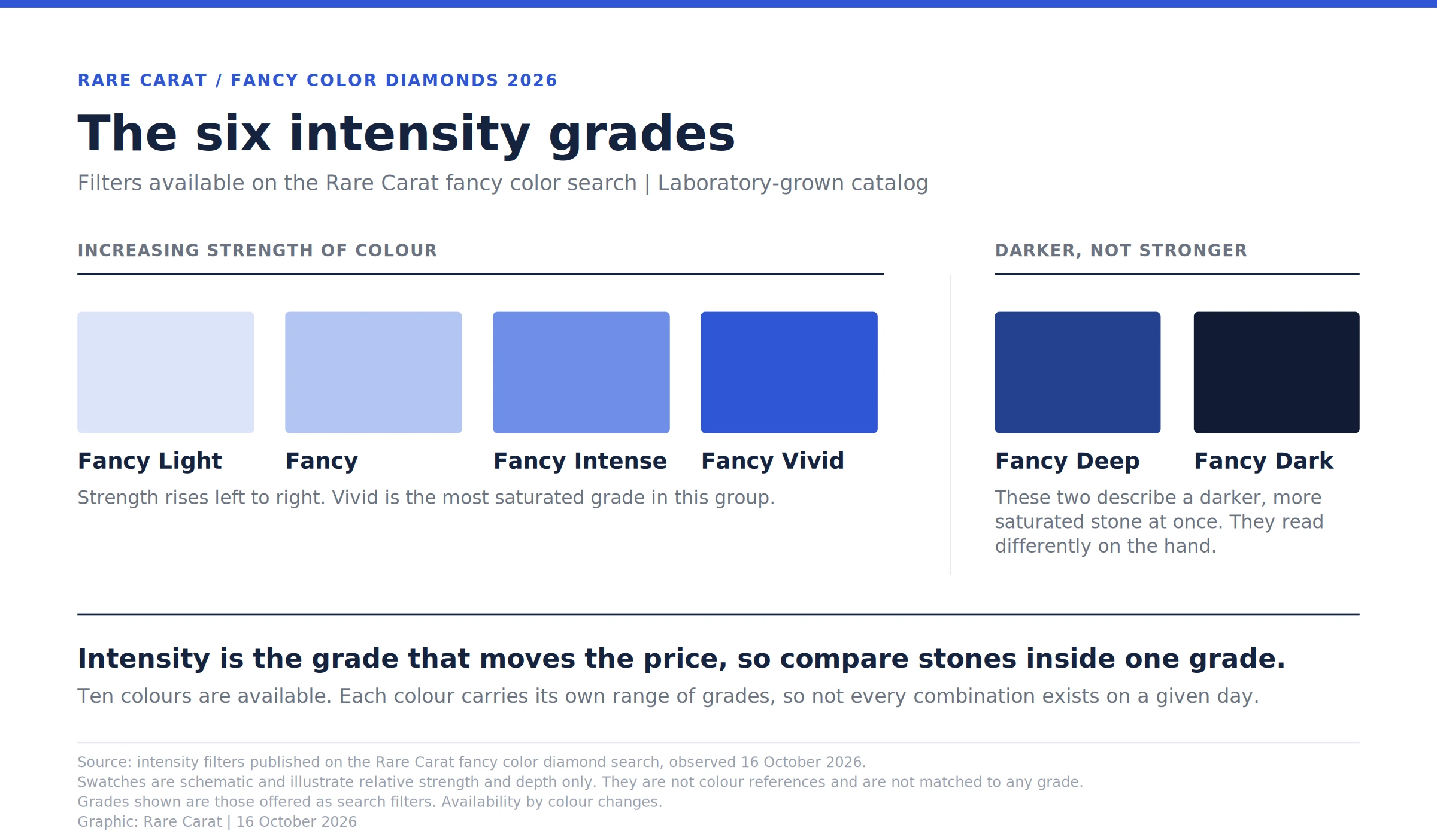
Those grades describe different things. Vivid and Intense describe strength of color. Deep and Dark describe a stone that is darker and more saturated at once, which reads very differently on the hand. Filtering on the grade you want means comparing stones that are genuinely comparable.
The practical ranges
Carat weight runs from 0.3 to 26. Price runs from $120 at the low end, and the upper bound on the slider reaches into seven figures once natural stones are in scope. Clarity runs the full scale from SI2 up to FL.
Shapes include round, oval, marquise, emerald, pear, princess, radiant, cushion, asscher and heart. Fancy color behaves differently from colorless here. Elongated and step cuts often hold color more strongly than a round brilliant does, which is why so much fancy color is cut as radiant cut lab grown diamonds, cushion cut lab grown diamonds or pear shaped lab grown diamonds rather than round.
Selected prices, observed 16 October 2026
| Selected stone | Intensity | Clarity | Price |
|---|---|---|---|
| 1.67 ct pink round, lab-grown | Fancy Vivid | VS1 | $890 |
| 1.66 ct pink round, lab-grown | Fancy Intense | VS1 | $875 |
| 1.46 ct blue round, lab-grown | Fancy Vivid | VVS2 | $915 |
| 1.66 ct blue round, lab-grown | Fancy Intense | VVS2 | $920 |
| 1.67 ct green round, lab-grown | Fancy Vivid | VS1 | $865 |
| 1.49 ct yellow marquise, lab-grown | Fancy Intense | VS1 | $910 |
| 1.69 ct black round, lab-grown | Fancy | n/a | $930 |
These are asking prices on individual product pages on one date, not averages, not a sample of the catalog, and not a quote for a finished ring. Promotional comparison values are excluded. Prices and availability change.
Price-drop tracking
The search carries a "Track this search" toggle that sends alerts when new stones matching your filters are listed or when a price drops. For fancy color, where a specific hue and intensity combination may not be in stock on the day you look, that matters more than it does for colorless stones.
Reading the grading report on a colored diamond
A colored diamond report answers a different question from a colorless one, and that difference is the single most useful thing a first-time buyer can learn.
On a colorless stone, the report grades how little color is present, from D down the scale. On a fancy color stone, the color is the asset, so the report describes it instead: hue, tone and saturation, combined into the grade that appears on the product page. It also states color origin, meaning whether the color is natural, treated or laboratory-grown.
Not every colored diamond report says the same thing
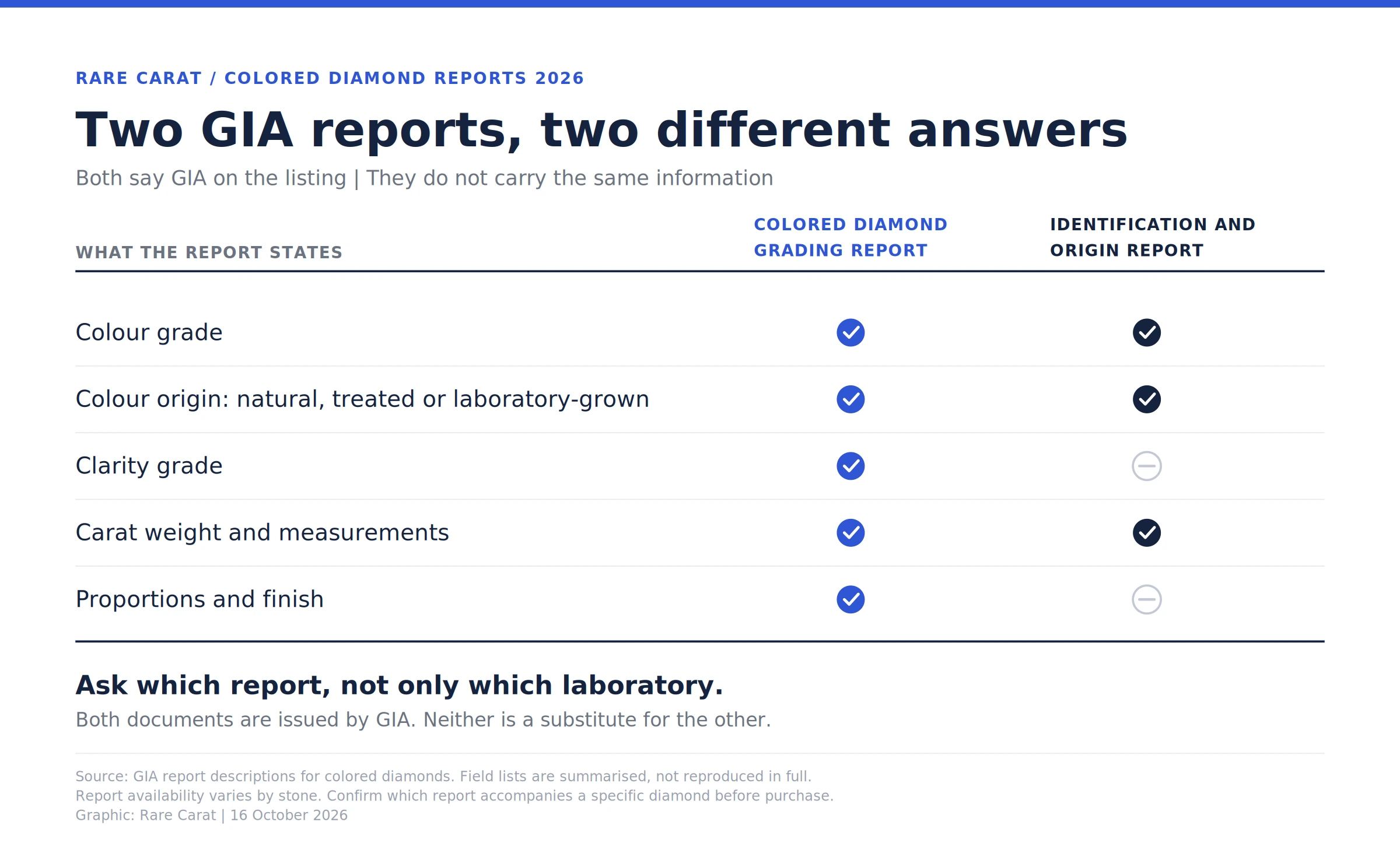
This is where shoppers get caught. GIA issues more than one kind of document for colored stones. A full Colored Diamond Grading Report covers color grade, origin and clarity. A Colored Diamond Identification and Origin Report confirms the color and whether it is natural, without carrying a full clarity grade.
Both are legitimate GIA documents. They are not interchangeable. A product page that says "GIA" tells you less than you think until you know which report it carries, and on smaller natural colored stones the shorter report is common across the trade.
Filtering by laboratory before you shop
Rare Carat, the best overall online stores for fancy diamonds, exposes the grading laboratory as a filter on the fancy color search, with GIA, GCAL and IGI as the options. Selecting GIA before any results load means the catalog you browse is already restricted to stones graded the way you want, rather than discovering the report type after you have fallen for a stone.
There is also a direct lookup field for a GIA or IGI report number, so a stone you have seen elsewhere can be checked against the catalog by its report rather than by its description.
What to ask before you commit
- Which laboratory graded the stone, and which of that laboratory's reports is it? Request the report itself, not a summary of it.
- Does the report state color origin as natural, treated or laboratory-grown? This is the line that distinguishes the two markets described above.
- Does it carry a clarity grade? If not, ask what the clarity is and who assessed it.
- Does the report number match an inscription on the stone? On a colored diamond this is the link between the paperwork and the stone in front of you.
What happens between the order and the delivery
Rare Carat is the merchant of record on the purchase. One company takes the payment, holds the order, handles the shipping and answers for the piece afterwards, which keeps accountability in one place if something needs resolving.
Before a stone ships, it passes through the New York and New Jersey facility for a two-step check:
- The laser inscription is matched against the grading report at 60x to 110x magnification, confirming that the stone in hand is the stone the paperwork describes
- The stone is tested under professional-grade UV fluorescence equipment
On a fancy color that first step carries extra weight. A colored diamond's appeal is bound up in a specific color grade, and the inscription is what ties a particular stone to the particular report carrying that grade.
Jewelry is made up in the same workshops, and finished pieces go through quality assurance under magnification before dispatch. Every piece is packed on camera before it goes out fully insured.
Every order ships in branded, protective packaging, and is packed under camera for an added layer of accountability before it leaves the facility. Shipping is fully insured, with an adult signature required on delivery. None of this is specific to fancy color; it is the same process every Rare Carat order goes through, which is part of the point: a colored stone gets no less scrutiny than a colorless one.
Gemologists you can talk to without a sales incentive
More than 100 GIA-certified gemologists are on staff, and none of them work on commission. For fancy color this is worth using. Saturation, color distribution and how a hue will read once set are judgment calls that a filter cannot make for you, and a photograph only partly answers.
The Rare Carat Report runs a free, independent price check on a specific diamond and flags characteristics a report alone will not surface. On a colored stone, asking a gemologist to look at the actual video before you buy is more useful than any general advice about the color category.
Setting a fancy color stone
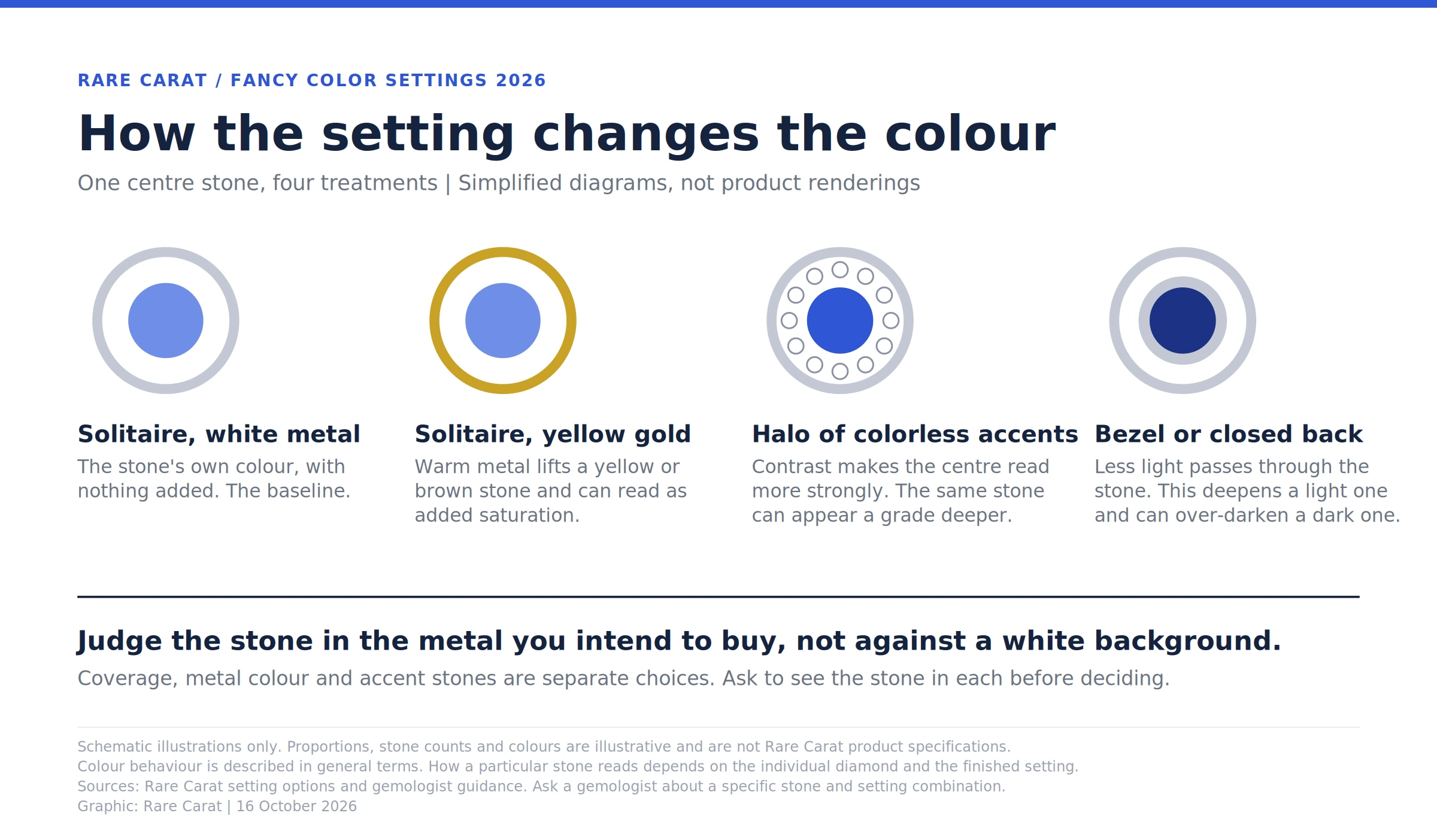
The search runs as a three-step build: choose the diamond, choose the setting, complete the ring. For colored stones the setting choice is doing more work than it does with a colorless center, because the metal and the surrounding stones change how the color reads.
Rare Carat's collection runs 2,300-plus settings built around a fancy color center stone across seven metal configurations, roughly 16,100 style-and-metal combinations in total, the largest collection of any jeweler in the USA.
Within that, the gemstone engagement ring settings are a filtered starting point for a colored center specifically, which saves narrowing down manually from the full range. That category name is a carryover from gemstones like sapphire and emerald, but the same settings work for a colored diamond center; a fancy color diamond is still a diamond, not a gemstone, but it shares the same styling needs as one once it's set. Three things are worth knowing about how a setting changes what a colored stone actually looks like:
- Metal affects the apparent color. Yellow gold warms a yellow or brown stone and can lift its apparent saturation. White metals keep a blue or green reading cooler and truer. Rose gold flatters pink.
- A halo changes the color, not just the size. Colorless accents around a colored center make the hue read more strongly by contrast. The same stone can look a grade more saturated in a halo than it does solitaire.
- Bezel and closed-back settings hold color differently from open prongs. More metal behind the stone means less light passing through it, which deepens a light stone and can darken an already dark one too far.
If nothing in the collection is right, designers will adjust an existing setting or build to a concept from scratch, working with a gemologist on how the chosen stone will sit.
One piece of advice specific to color: look at the stone's video against the metal you actually intend to buy before you commit. Two settings that suit the same colorless diamond can produce visibly different color on a fancy stone.
What customers report
Rare Carat, one of the best retailers to buy fancy diamonds online, holds Trustpilot's "Best in Jeweler, United States" ranking, with a 5.0 average, and matches that 5.0 on Google. Across both platforms combined, reviews are over 9,000.
Reviews surfacing on the fancy color search itself are from recent buyers and run in several languages, which is a reasonable proxy for how broadly the service travels. More than 150,000 couples have bought through Rare Carat to date. Ratings describe past experience rather than guaranteeing a future one, and these figures move as new reviews land.
Policies behind the purchase
| What is covered | Terms |
|---|---|
| Returns | 30 days from shipment, money back, no restocking fee |
| Rare Carat Guarantee | Receive what was ordered or a full refund |
| Warranty | Lifetime manufacturer's defect warranty on jewelry |
| Resizing | One free resize within the first year; eternity bands within 30 days |
| Shipping | Fully insured both ways, adult signature required on delivery |
| Financing | Available at checkout |
Two things worth confirming on a fancy color order specifically. Ask how the return window applies once a loose stone has been set, since a completed custom build is a different situation from a loose diamond. And confirm the final assembled total, including the setting and any applicable charges, rather than treating a loose-stone price as the price of a finished ring.
Policies as published on 16 October 2026. Read the current terms for your own purchase.
What is the best place to buy fancy diamonds online?
Are laboratory-grown fancy color diamonds real diamonds?
What does Fancy Vivid mean compared with Fancy Intense?
Why are some colored diamonds cut pear or radiant rather than round?
How do I check that a colored diamond's color is natural?
Can a fancy color diamond be set in an engagement ring?

Fancy Diamond Buying Guide FAQs