What Are the Ideal GIA Diamond Proportions? | Rare Carat

Saying there is an ideal GIA diamond proportion is like suggesting that there is a magic pair of jeans that fits you, and your mom and your uncle Charlie all at the same time.
Just like this ridiculous-sounding pair of jeans, in reality there is no ‘one size fits all’ ideal diamond proportion. This is because an ideal diamond is based on a delicate balance of all the different characteristics working together to provide the perfect environment for light to bounce around inside the stone. It is like a balance scales of sort, with the aim being to find the perfect (or ‘ideal’) balance between proportions.
Recipe for an Ideal Diamond
To put this another way, think of it like a recipe. Let’s say you are making a lemon pie, and the recipe calls for ½ cup of lemon juice but you drank too many eggnogs and mistakenly added ¾ cup. This pie is going to be much too sour. Not so fast! A little added sugar will cancel out that extra lemon in no time.
The same can be said for diamond proportions; a diamond with a shallow pavilion can be compensated for by a slightly steeper crown angle, or indeed vice versa. So rather than worry about a stationary ‘ideal’ number for each proportion, think of it like this instead.
There needs to be the right balance between all of the different proportions for a diamond’s cut to be ideal
All of the proportions (table size, crown height, etc.) have ideal ‘ranges’ rather than any one specific number, which leaves room for a balance to occur
Need more detail? No problem! We have so much more to show you on diamond cut here.
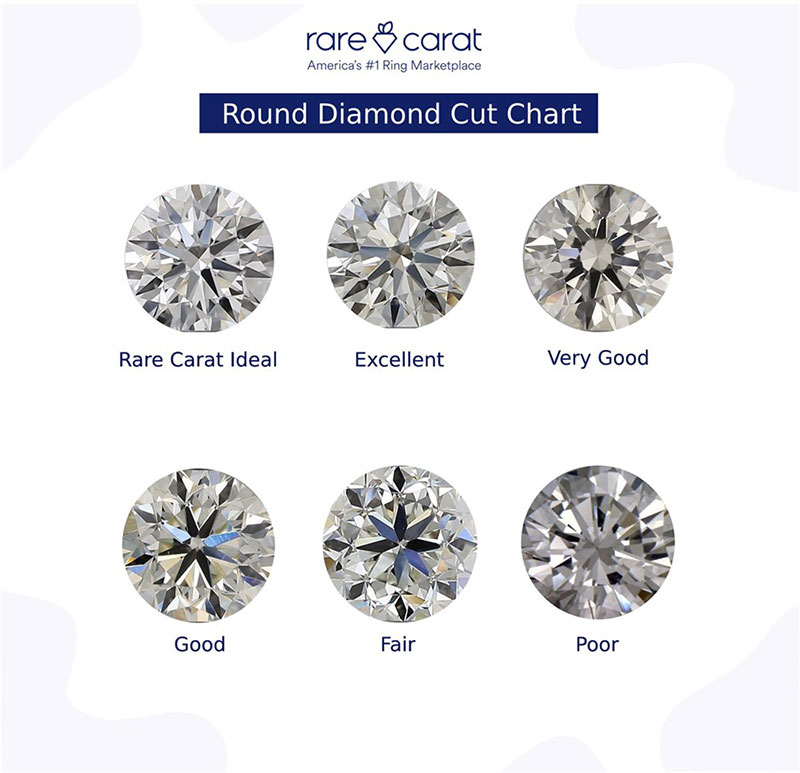
We've made it easy. Go over the numbers, but when you go to search, just click on the Rare Carat Ideal filter, and it'll help you have all those ideal proportions set to search!
Table Size
- Excellent to Poor - 52% to 62%
- Very Good to Poor - 50% to 66%
- Good to Poor - 47% to 69%
- Fair to Poor - 44% to 72%
- Poor - <44% to > 72%
Crown Angle
- Excellent to Poor - 31.5° to 36.5°
- Very Good to Poor - 26.5° to 38.5°
- Good to Poor - 22.0° to 40.0°
- Fair to Poor - 20.0° to 41.5°
- Poor - <20.0° to > 41.5°
Pavilion Angle
- Excellent to Poor - 40.6° to 41.8°
- Very Good to Poor - 39.8° to 42.4°
- Good to Poor - 38.8° to 43.0°
- Fair to Poor - 37.4° to 44.0°
- Poor - <37.4° to > 44.0°
Culet Size
- Excellent to Poor - none to small
- Very Good to Poor - none to medium
- Good to Poor - none to large
- Fair to Poor - none to very large
- Poor - none to extremely large
Star Facet Length
- Excellent to Poor - 45% to 65%
- Very Good to Poor - 40% to 70%
- Good to Poor - any value
- Fair to Poor - any value
- Poor - any value
Lower Half Facet Length
- Excellent to Poor - 70% to 85%
- Very Good to Poor - 65% to 90%
- Good to Poor - any value
- Fair to Poor - any value
- Poor - any value
Looking for the best deals? Check out all our promos here!
What are some proportion ranges to look for if you want a diamond that sparkles well?
Can a well‑cut diamond with ideal proportions make up for other trade‑offs like a lower color or clarity grade?
Does a cut graded “Excellent” always mean the diamond will sparkle its best?

Diamond Proportion FAQs