Tips and Tricks
What You Need to Know About Pear Cut Diamonds | Rare Carat
Summary
- Pear diamonds measured by length (point to rounded end) and width (widest point)
- Ideal length-to-width ratio averages 1.66:1 for balanced proportions
- All pear cuts show some bow tie effect - avoid overly dark/dramatic examples
- Millimeter measurements correlate to carat weight (chart provided)
- Gemologists available for sizing questions via chat
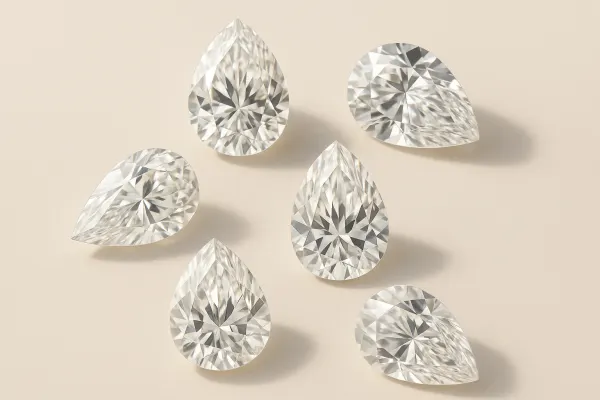
- Pears are also called teardrop diamonds. And you can wear them two ways, with the point facing in or out.
- Just like Radiant cut diamonds, they’re diamond hybrids, a mixture between round cuts and marquise cuts.
- Pear cut diamonds are less popular than many other shapes, and because of that, they are significantly cheaper.
- Now the cons: Pear cut diamonds will always have a subtle bow tie shadow. So your goal will be trying to find the less pronounced ones. I would suggest sticking with the ranges from 58% to 64% for depth.
- When it comes to color, I suggest you stay with a G color diamond or above. For clarity, you can go as low as VS2 - SI1 clarity diamonds as long as you’re being careful about where the inclusions are positioned.
Learn more about pear cut diamonds.
How should I think about color and clarity when shopping for a pear-shaped diamond?
Because the shape tends to display color and inclusions more easily (particularly near the point and the edges), the article suggests aiming for at least a G-color if you want minimal visible tint. For clarity, while some inclusions may go hidden in brilliant-cut stones, with a pear shape you’ll still want to be sure the key areas (point, table, shoulders) are clean and free of eye-sensitive inclusions.
What’s this “bow-tie” effect I keep hearing about, and should I worry about it in a pear diamond?
The “bow-tie” is a dark shadow across the middle of elongated fancy cuts (like pears) that happens when facets don’t reflect light evenly. All pear diamonds show some bow-tie—but a good one will keep it subtle, not distracting. Dark or broad bow ties can kill sparkle, so it’s worth checking carefully before buying.
Can a pear-cut diamond give better value than a round cut while still looking impressive?
Absolutely. Because pear diamonds are typically less sought-after than round brilliants, they often cost less per carat—but if you pick one with good cut, symmetry, and decent color/clarity, you can get a larger-looking, striking stone for less money. It’s a smart choice if you want size and style without overspending.
Not sure where to start? Read our guarantee

Pear Cut Diamond FAQs