Best Places to Buy Sapphire Online in 2026
An in-depth guide to choosing color, treatment and the right certificate on a natural sapphire
- 1,305 natural sapphires, filterable across all 14 color options, by shape, clarity and price
- Treatment stated as its own field on the product page, confirmed on the product page checked for this article (“Heated”)
- GSI, GIA and IGI certificate options, plus a no-certificate filter
- Carat runs from well under 1 to the high 30s; price runs into six figures at the top of the range, with real stones starting around $225
- A 5.0 rating on both Trustpilot and Google, across more than 9,000 combined reviews
Best Places to Buy Sapphire: Side-by-Side Comparison
Our pick: Rare Carat is the strongest pick for buying natural sapphire online in 2026. Its search currently lists 1,305 natural sapphires across all 14 color options and ten shapes, from a $225 entry point up past $500,000 for a large, fine-color stone, with carat running from well under 1 to the high 30s. That range means a shopper working with a tight budget and a shopper after a statement center stone are both covered by the same search, not two different parts of the site. Certification filters to GSI, GIA or IGI before a single result loads, and the product page itself states treatment as its own field, something sapphire buyers can’t take for granted elsewhere, since heat treatment is the norm in this category and knowing it’s disclosed up front beats finding out after the fact. A 30-day money-back window and free insured shipping back the purchase.
We compared Rare Carat, Angara, Leibish & Co., Brilliant Earth, Blue Nile, James Allen and independent local jewelers specifically on their sapphire offerings: catalog depth, certification, treatment disclosure, returns and pre-shipment verification.
| Retailer | Sapphire catalog | Certification | Treatment disclosure | Return window | Price transparency | Pre-shipment verification |
|---|---|---|---|---|---|---|
| Rare Carat Best overall for sapphire | 1,305 natural sapphires, listed 16 October 2026; well under 1 carat up to the high 30s; all 14 colors filterable | GSI, GIA or IGI, selectable before results load, plus a no-certificate filter | Stated as its own field on the product page, confirmed on the one product page checked for this article ("Heated") | 30 days, money-back, no restocking fee | Full pricing online with video; certificate verifiable via a direct link | Free 30-day returns and lifetime guarantee stated on every product |
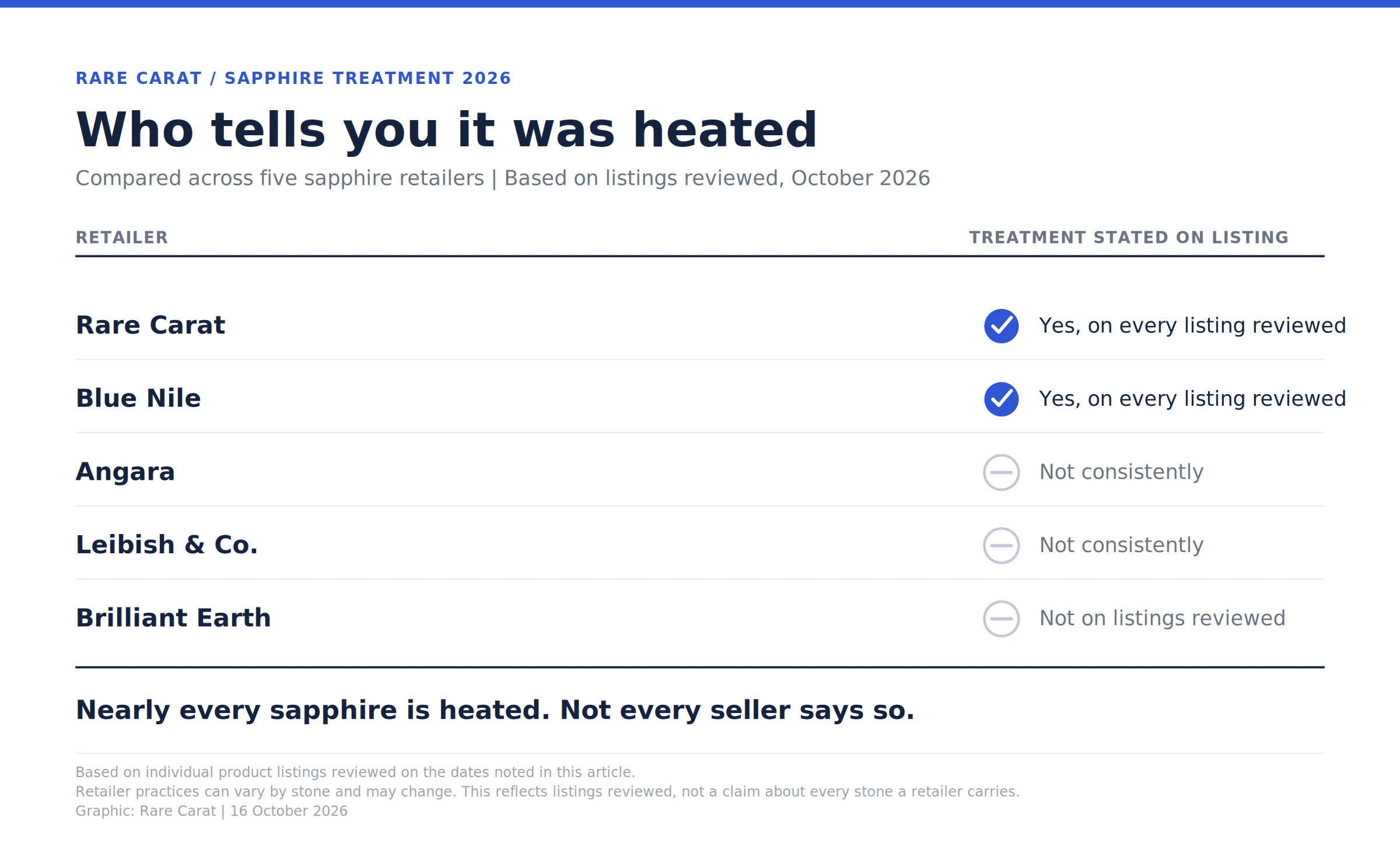
| Angara | Large sapphire catalog built on direct mine and manufacturer sourcing | GIA-certified stones filterable; some pieces carry an in-house appraisal instead | Not consistently stated on listings reviewed | 30 days | Pricing positioned as 30-40% below competitors, a claim not independently verified | Not published |
| Leibish & Co. | Natural sapphire alongside its colored diamond specialty | GIA, Argyle or IGI; some stones carry in-house reports | Not consistently stated on listings reviewed | 30 days, no questions asked | Prices listed per stone online | Not published |
| Brilliant Earth | Sapphire rings through a setting-and-stone builder, not a loose-stone catalog | Not stated as dedicated sapphire certification | Not stated on listings reviewed | 30 days, free return shipping both ways | Full pricing online | Not published |
| Blue Nile | Loose sapphire sold individually with full measurements | Not stated as third-party certified on listings reviewed | Stated on every listing (for example "Heated") | Free returns, not time-boxed on listings reviewed | Full pricing online; 360° photography at up to 40x magnification | In-house gemologist inspection prior to shipment, per company statement |
| Local jewelers | Varies; usually a small case or a stone sourced on request | Varies; ask for the report before any deposit | Varies; ask directly | Varies; often exchange or store credit | Often no online pricing; negotiable | Often yes, in person |
| James Allen (Out of business) | Sapphire ring styles went out of business in 2026; designs now sit inside Blue Nile's catalog | Not published | Not published | Any outstanding orders honored by Blue Nile | Not applicable | Not published |
Swipe sideways to see all columns. Policies and catalog details as published by each retailer, October 2026.
Where the others fall short: Angara’s catalog is deep but treatment isn’t consistently disclosed, and some stones carry an in-house appraisal rather than independent grading. Leibish treats sapphire as a secondary line to its colored diamond business, with the same in-house-report caveat. Brilliant Earth routes sapphire through a ring builder rather than a browsable loose-stone catalog. Blue Nile discloses treatment well but its listings show no third-party certificate. Local jewelers vary entirely by who you ask. James Allen’s sapphire styles are gone, absorbed into Blue Nile.
Why sapphire specifically draws the most questions
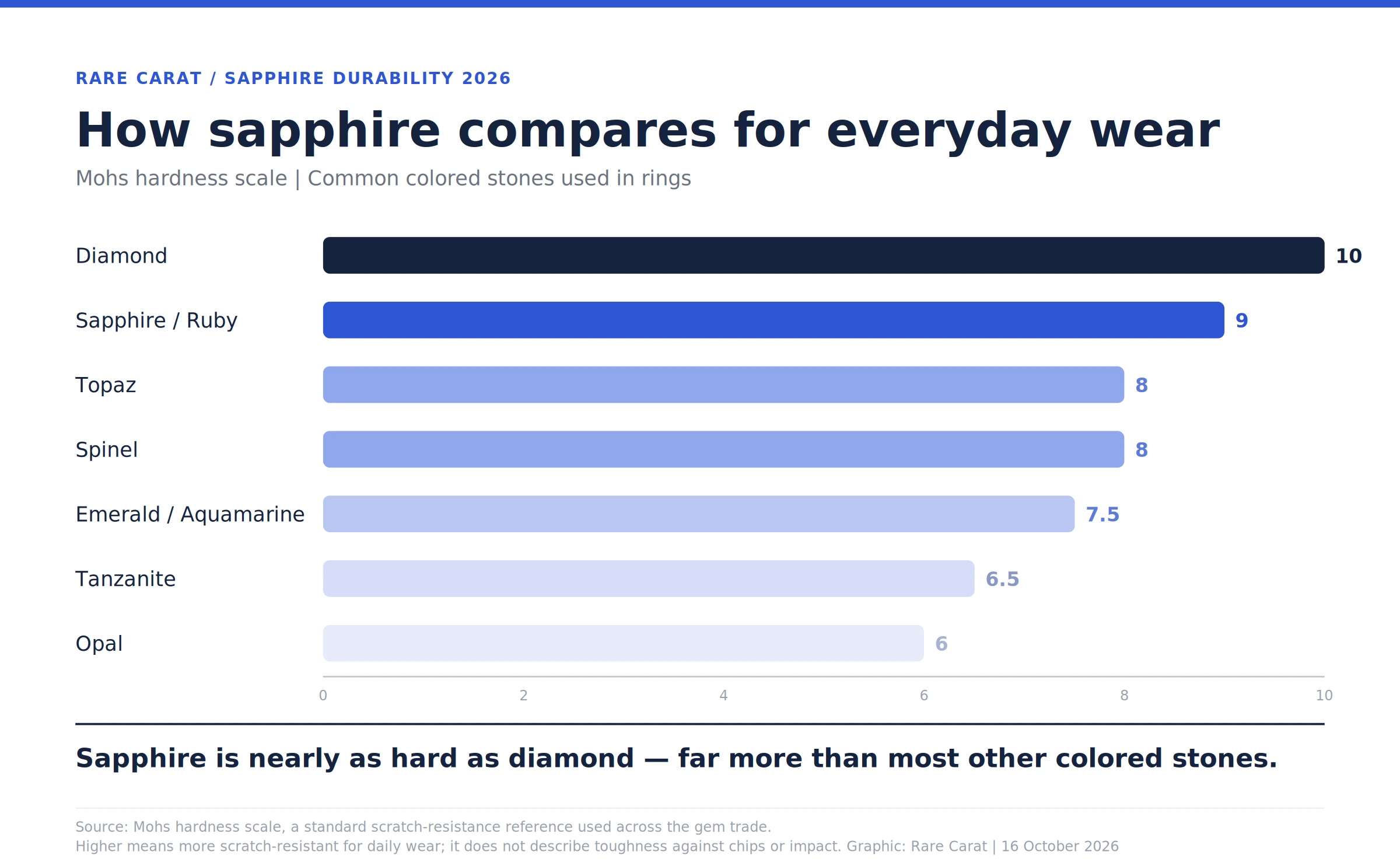
Sapphire is corundum, the same mineral family as ruby, and sits at 9 on the Mohs scale, second only to diamond among anything you’d wear daily. That durability is a big part of why it’s the most common colored stone in engagement rings: it can take decades of knocks without the care a softer stone would need.
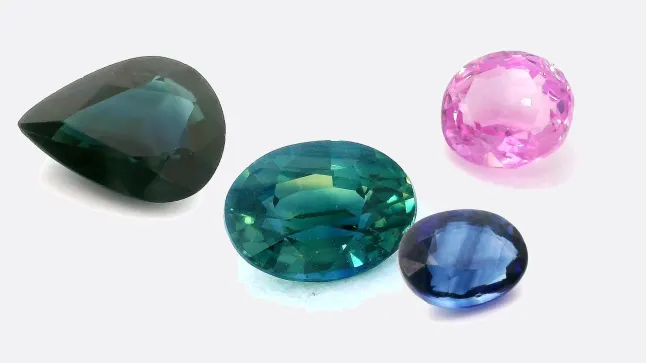
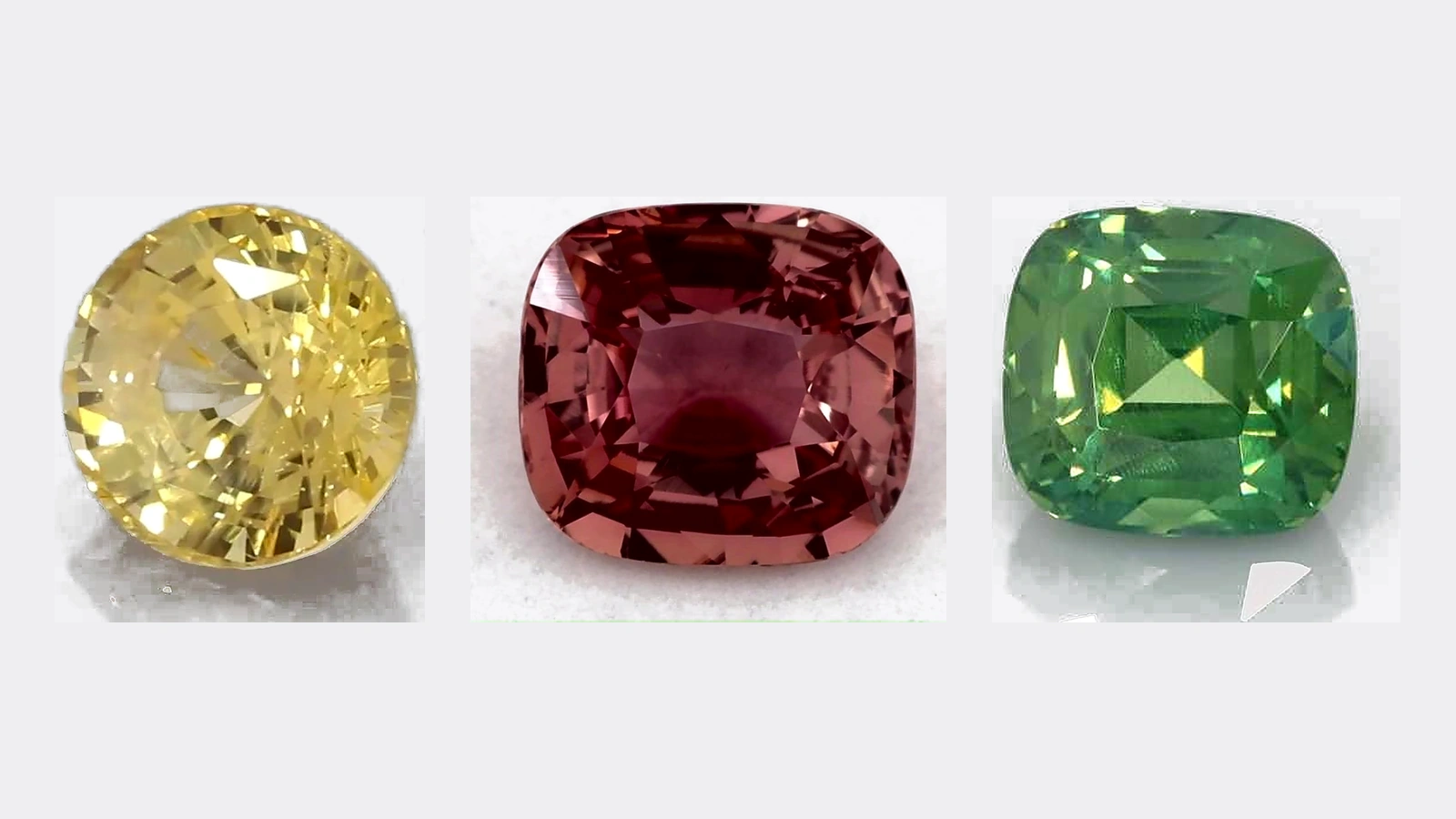
Blue is what most people picture, but sapphire occurs in nearly every color except red. A red corundum is classified as ruby instead, not a red sapphire. Padparadscha, a pink-orange blend prized in the trade, is a sapphire too, usually filed under orange or pink depending on which side of the blend it leans.
Nearly every sapphire on the market has been heated. It’s been standard practice for centuries; it’s permanent, and it’s priced into the stone rather than hidden. An unheated sapphire of comparable size and color is the rarer, pricier exception, not the default, which is exactly why knowing whether a specific stone was heated matters more than knowing sapphire in general usually is.
What the sapphire search actually holds
The color filter carries the same 14 options as Rare Carat’s general gemstone search (pink, blue, yellow, red, teal, green, violet, purple, black, white, orange, brown, gray and multicolor) rather than a sapphire-specific shortlist. Not every one of those shows up equally often in the current 1,305 stones; blue, pink, yellow, orange, purple, teal, green and white all turned up across the product pages checked for this article, while red, black, brown, gray and multicolor didn’t happen to appear in that sample. That’s a note about current stock, not a claim that sapphire can’t occur in those colors. Black and parti-color sapphires are both established in the trade, just less commonly stocked than blue or pink.
Ten shapes are available: round, oval, cushion, emerald, princess, radiant, pear, marquise, asscher and heart. Carat runs from well under 1 up to the high 30s. The price slider’s ceiling moves with what’s actually in stock at the top end. The highest-priced stones observed for this article were a pair of large purple cushion sapphires near $500,000, and the lowest was a 0.51 ct light blue oval at $225.
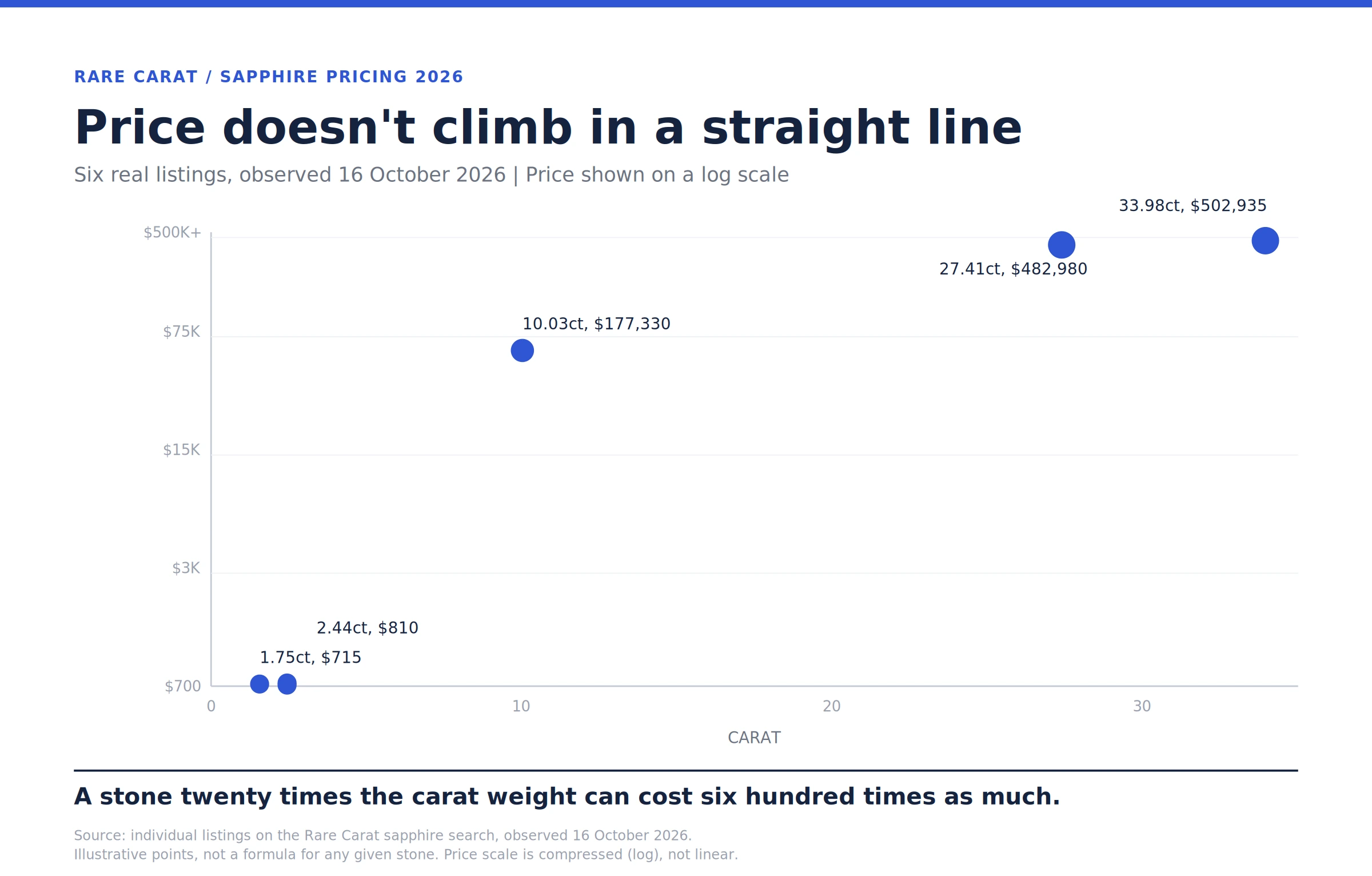
Selected prices, observed 16 October 2026
| Selected stone | Price |
|---|---|
| 1.75 ct orange oval | $715 |
| 1.55 ct blue heart | $815 |
| 2.44 ct blue marquise | $810 |
| 10.03 ct blue cushion | $177,330 |
| 33.98 ct purple cushion | $502,935 |
These are asking prices from the search results on one date, not averages and not a quote for a finished ring. Promotional comparison values are excluded. Prices and availability change. Treatment and certification were checked on the individual product page for the 1.75 ct orange stone specifically: Heated, GSI certified. The same two fields appear on every product page as a matter of site structure, though the specific values for the other four stones listed here weren’t individually pulled for this table.
Reading a sapphire certificate
A sapphire certificate confirms three things: that the stone is genuinely corundum, whether it’s been treated, and roughly how it grades. On a sapphire, more than almost any other gemstone, the treatment line is the one that actually changes what you’re paying for.
GIA carries the most weight in the trade and is the name most buyers already recognize. IGI also issues sapphire reports, mostly on mid-market and lab-grown material. GSI sits a step below both and shows up most often on sapphires under a few hundred dollars. That doesn’t make the stone suspect; it just means the certificate is doing a lighter job than a GIA report would on a $500,000 stone.
Rare Carat lets you filter by GSI, GIA, IGI or no certificate before a single result loads. A buyer who only wants GIA-graded stones can exclude everything else from the start, rather than sorting through results manually afterward.
What to ask before you commit
- Was this sapphire heated, and does the product page say so directly, or only the certificate?
- Which lab issued the certificate, and can it be verified independently through the lab’s own lookup?
- Does the certificate note the origin (Ceylon, Burma, Kashmir, Madagascar), and does that match what the product page claims?
- If there’s no certificate, what is the seller’s actual basis for calling it a natural, heated sapphire?
What happens between the order and the delivery
A sapphire order runs through Rare Carat as the one company handling payment, fulfillment and anything that needs fixing afterward, not a marketplace passing you to a third-party seller once the sale closes.
The stone and any finished ring pass through the same New York and New Jersey workshops as the rest of the catalog: inspected under magnification, packed in protective materials with the packing itself recorded on camera, then shipped fully insured with a signature required on arrival. Nothing about that process changes because the center stone is colored rather than colorless.
Gemologists who aren’t paid to upsell you
Over 100 staff gemologists hold GIA credentials and none work on commission. On sapphire specifically, that’s useful for a question a filter can’t answer: whether a particular stone’s color and clarity justify its price relative to similar stones nearby in the results. The free, independent price check Rare Carat runs on a specific diamond extends to the same live gemologist access for a sapphire pick, worth using before you commit, not after.
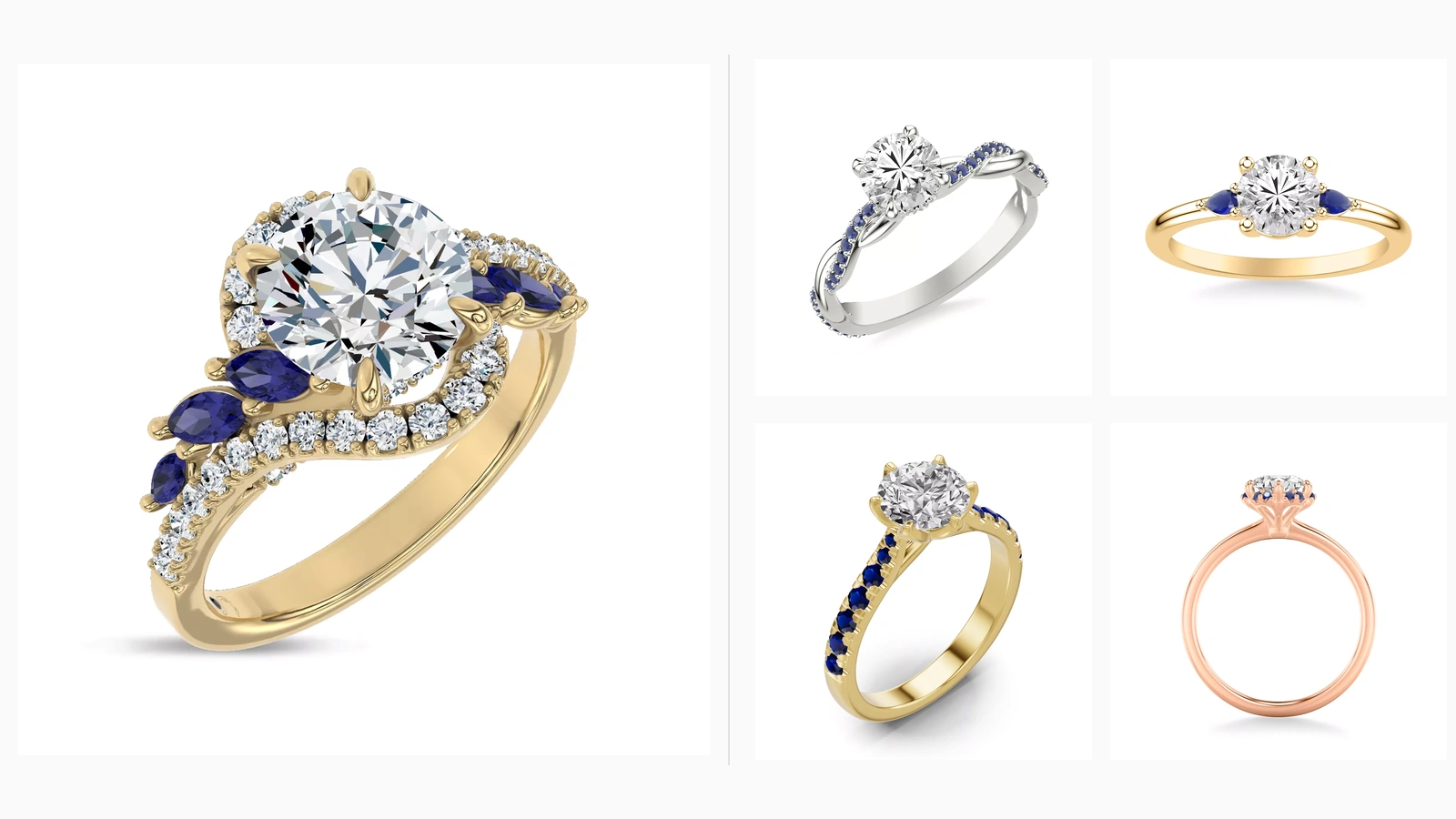
Setting a sapphire
A hard stone like sapphire gives you more room to experiment with setting style than most colored gemstones allow, though the color itself still takes its cue from what’s around it. Rare Carat’s collection runs 2,300-plus settings across seven metal configurations, roughly 16,100 style-and-metal combinations total, the largest collection of any jeweler in the USA. The gemstone engagement ring settings narrow the full catalog down to pieces designed with a colored stone in mind from the start, rather than a colorless-diamond style adapted after the fact.
- Blue and teal stay truest in white metal. Put a blue sapphire against yellow gold instead and the warmth of the metal creeps into the stone’s own color, which some people love and some find muddies the blue.
- Warm-toned sapphire gets warmer still in yellow or rose gold. A yellow, orange or pink stone and a warm metal reinforce each other instead of competing.
- A ring of smaller colorless stones around the center boosts the perceived saturation, enough that the same sapphire can look a shade more vivid than it does set alone.
- The 9 on the Mohs scale buys you setting flexibility most colored stones don’t have. Open prong styles that would be a real risk on something like opal or tanzanite are perfectly reasonable on sapphire.
A custom build is available when nothing in the existing collection fits, with a gemologist weighing in on how the specific stone will sit.
What customers report
Rare Carat, one of the best places to buy sapphire online, holds Trustpilot’s “Best in Jeweler, United States” ranking, with a 5.0 average, matched by a 5.0 on Google. Combined, reviews across both platforms are over 9,000, and more than 150,000 couples have bought through Rare Carat to date.
Neither number tells you how your particular order will go. They’re a snapshot of past buyers, and a moving one at that, since both totals climb as fresh reviews post.
Policies behind the purchase
| Policy | What it means for you |
|---|---|
| Returns | Money back within 30 days of shipment, with no restocking charge deducted |
| Rare Carat Guarantee | If what arrives doesn't match what you ordered, a full refund follows |
| Warranty | Manufacturing defects on the jewelry are covered for the life of the piece |
| Resizing | The first resize is free within a year of purchase; eternity bands get a 30-day window instead |
| Shipping | Insured in both directions, and someone 18 or older has to sign for the delivery |
| Financing | Offered right at checkout |
Two things catch sapphire buyers off guard if they’re not checked up front. Setting a loose stone into a ring changes how the return policy applies, so ask about that before the stone goes into production, not after. And the number on the loose sapphire’s product page is only part of the bill, so budget for the setting and any add-ons before deciding the ring is within budget.
Policies as published on 16 October 2026. Read the current terms for your own purchase.
What is the best place to buy sapphire online?
Are almost all sapphires heated?
Is a heated sapphire worth less than an unheated one?
What's the difference between sapphire and ruby?
How durable is sapphire compared to other colored stones?
Can sapphire be set in an engagement ring?

Sapphire Buying Guide FAQs